
Water Quality Monitoring Systems Market Report Scope & Overview:
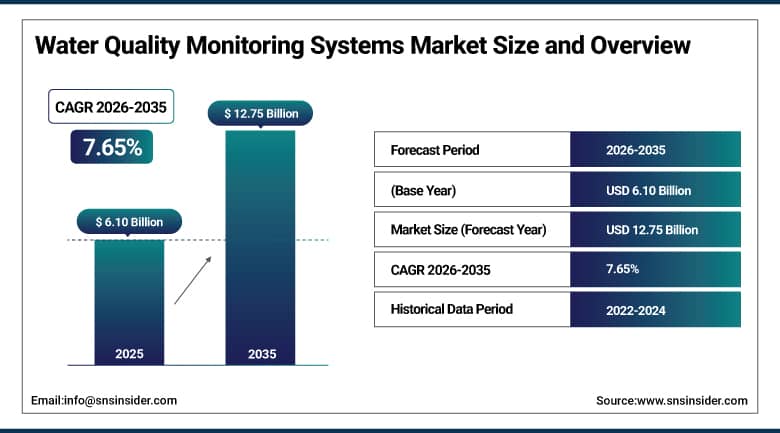
The Water Quality Monitoring Systems Market size was valued at USD 6.10 Billion in 2025 and is expected to reach USD 12.75 Billion by 2035, growing at a CAGR of 7.65% from 2026 to 2035.
Utilities, industrial operators, and environmental regulators are steadily replacing manual grab-sampling routines with continuous, sensor-based surveillance of aqueous systems, and this shift is the single biggest force behind market expansion. Deteriorating source-water quality, tightening discharge limits, and the emergence of contaminants such as PFAS and microplastics are pushing municipal and industrial operators toward instrumentation capable of detecting subtle chemical and biological changes in near real time. At the same time, the falling cost of multiparameter sondes, optical sensors, and cellular or satellite telemetry is bringing continuous monitoring within reach of smaller utilities, aquaculture operators, and agricultural users that previously relied on infrequent laboratory testing.
Xylem Inc. completed its acquisition of TriOS Mess- und Datentechnik GmbH in 2026, a German developer of UV-Vis optical sensing systems, to extend its real-time nutrient and organic-pollutant detection portfolio across municipal, industrial, and marine water quality applications, underscoring how established instrumentation vendors are consolidating optical sensing capability to compete against a fast-growing field of specialized sensor developers.
To Get More Information On Water Quality Monitoring Systems Market - Request Free Sample Report
Water Quality Monitoring Systems Market Trends:
-
Rising incidence of emerging contaminants, including PFAS, pharmaceuticals, and microplastics, is prompting utilities and regulators to deploy advanced sensors capable of detecting trace-level pollutants beyond conventional parameters.
-
Growing integration of IoT-enabled telemetry, cloud dashboards, and AI-based anomaly detection is transforming water quality monitoring from periodic sampling into continuous, predictive surveillance.
-
Expansion of decentralized and remote monitoring networks across rivers, reservoirs, and coastal zones is increasing demand for low-power, self-calibrating sensor nodes with extended field-deployment life.
-
Stricter regulatory frameworks, including evolving EPA standards, the EU Water Framework Directive, and expanding drinking-water safety mandates in Asia Pacific, are compelling municipalities and industries to upgrade legacy monitoring infrastructure.
-
Strategic acquisitions and partnerships among established instrumentation manufacturers and specialized optical- and biosensor start-ups are accelerating the pace of product innovation and portfolio consolidation.
U.S. Water Quality Monitoring Systems Market Size Outlook:
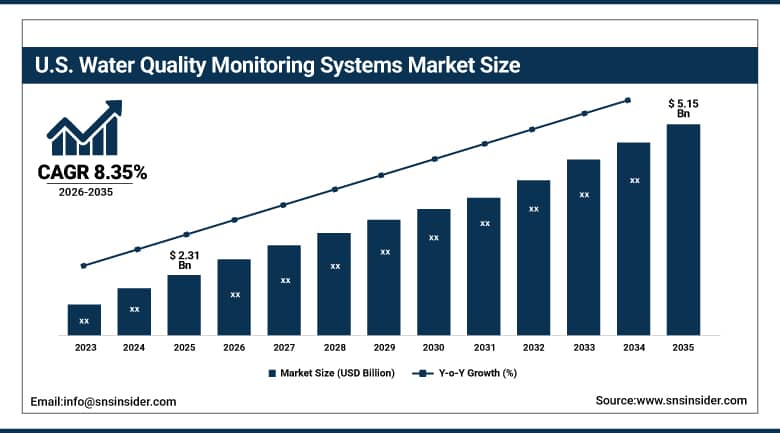
The U.S. Water Quality Monitoring Systems Market was valued at USD 2.31 Billion in 2025 and is projected to reach USD 5.15 Billion by 2035, growing at a CAGR of 8.35% during 2026–2035.
The U.S. Water Quality Monitoring Systems Market is forecasted to expand steadily through 2035, supported by aging water infrastructure, stringent EPA enforcement, and substantial federal funding directed toward drinking-water and wastewater modernization. The Bipartisan Infrastructure Law and related state-level programs continue to channel capital toward smart-metering and continuous-monitoring upgrades at municipal treatment plants, while a dense concentration of instrumentation manufacturers headquartered in the country supports rapid technology adoption. Industrial users in the chemicals, pharmaceuticals, semiconductor, and food and beverage sectors are also increasing investment in process water monitoring to meet discharge-permit obligations and reduce the operational risk associated with contamination events.
In 2025, the U.S. Environmental Protection Agency's finalized PFAS drinking-water limits pushed many municipal utilities to accelerate procurement of continuous online analyzers capable of trace-level per- and polyfluoroalkyl substance detection, a compliance deadline that instrumentation vendors including Hach and Thermo Fisher Scientific cited as a material driver of near-term demand for advanced water quality monitoring equipment.
Water Quality Monitoring Systems Market Segment Analysis:
-
By Component, Sensors & Probes led the Water Quality Monitoring Systems Market with a 34.20% share in 2025, while Software & Data Management Platforms is the fastest-growing component segment with a CAGR of 10.85% from 2026-2035.
-
By Technology, Online/Continuous Monitoring led the Water Quality Monitoring Systems Market with a 54.30% share in 2025, while Portable/Handheld Monitoring is the fastest-growing technology segment with a CAGR of 9.10% from 2026-2035.
-
By Application, Wastewater Treatment led the Water Quality Monitoring Systems Market with a 29.80% share in 2025, while Aquaculture & Marine Monitoring is the fastest-growing application segment with a CAGR of 10.20% from 2026-2035.
-
By End User, Municipal Utilities led the Water Quality Monitoring Systems Market with a 38.60% share in 2025, while Government & Environmental Agencies is the fastest-growing end user segment with a CAGR of 9.75% from 2026-2035.
-
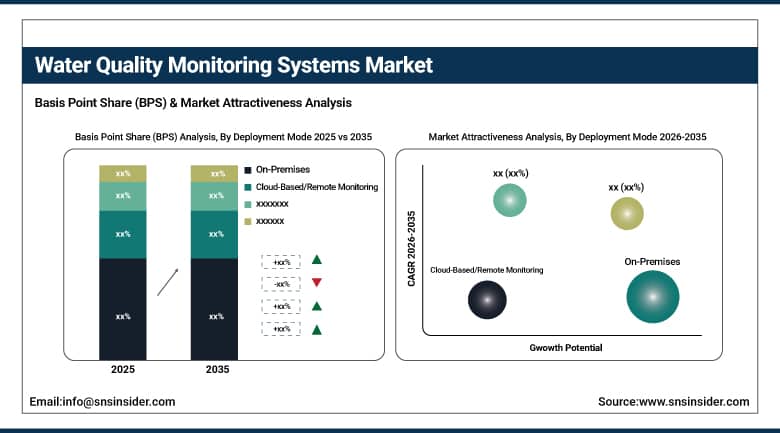
By Deployment Mode, On-Premises led the Water Quality Monitoring Systems Market with a 58.40% share in 2025, while Cloud-Based/Remote Monitoring is the fastest-growing deployment mode segment with a CAGR of 11.30% from 2026-2035.
On-Premises Systems Hold Share as Cloud-Based Monitoring Expands Rapidly
The On-Premises segment captured the highest share of 58.40% in the Water Quality Monitoring Systems Market in 2025 due to several factors, including the preference of many large utilities and industries for their own on-premises monitoring and control systems integrated with their current SCADA and automation systems. The benefits of the on-premises solution can be attributed to many customers with stringent data sovereignty policies, legacy IT infrastructure or network connectivity issues.
The Cloud-Based/Remote Monitoring segment is expected to grow at the fastest CAGR of 11.30% over the forecast period of 2026-2035 owing to the declining costs of data transmission, better connectivity in rural areas and increasing demand from utilities for a centralized multi-site view without having to set up on-site servers. Cloud-based solutions make it easier for smaller municipal authorities and decentralized organizations to benefit from advanced analytics capabilities.
Sensors & Probes Anchor the Market as Software Platforms Accelerate
Software & Data Management Platforms are expected to show the highest CAGR of 10.85% during the forecast period 2026-2035, driven by an overall transition in the industry towards the provision of monitoring services rather than just equipment sale. In view of the increasing amounts of sensor data collected by utilities and industries, there is a need for software solutions that are able to collect multi-location measurements, detect deviations, and create reports that meet regulatory requirements automatically. Cloud dashboards, mobile alerts, and predictive analytics powered by artificial intelligence are increasingly used by instrument providers as differentiators that enable them to secure long-term service contracts rather than hardware purchases.
The Software & Data Management Platforms segment is projected to register the fastest CAGR of 10.85% during the forecast period 2026-2035, reflecting a broader shift in the industry from selling standalone instruments toward delivering integrated monitoring-as-a-service offerings. As utilities and industrial operators accumulate large volumes of sensor data, the value of that data increasingly depends on software capable of aggregating multi-site readings, flagging anomalies, and generating compliance-ready reports without manual intervention. Cloud-based dashboards, mobile alerting, and AI-driven predictive analytics are becoming differentiators that instrumentation vendors use to lock in long-term service relationships rather than one-time hardware sales.
Continuous Online Monitoring Dominates as Portable Devices Gain Momentum
The Online/Continuous Monitoring category commanded the dominant revenue share of 54.30% in the Water Quality Monitoring Systems Market in 2025, which is attributed to the increasing demand from both municipal water utility companies and major industrial players for real-time monitoring of water quality parameters, compared to periodic monitoring. The advantage of this technology lies in the fact that in cases of contamination incidents, breakdowns in treatment processes, and even malfunction of the monitoring system itself, operators are able to identify issues within minutes, not hours or days, as would be needed for grab sample analysis in laboratory conditions. This capability is especially important for organizations with strict regulatory requirements, in which case early identification of exceedances can significantly lower risks and costs associated with noncompliance.
The Portable/Handheld Monitoring category will witness the highest CAGR of 9.10% during the forecast period 2026-2035, fueled by the increasing field testing activities of environmental consulting firms, aquaculture organizations, and small municipal systems that lack the necessary financial resources for establishing online monitoring networks. The new generation of portable and handheld multiparameter analyzers provides lab-grade precision in the most rugged battery-powered format.
Wastewater Treatment Leads Demand as Aquaculture Monitoring Expands Fastest
Wastewater Treatment held the largest revenue share of 29.80% in 2025 owing to the rising requirements for stringent discharge permits along with the need to monitor the treatment efficiency at different levels of the wastewater treatment process. Discharges from utilities or industries must monitor parameters like biochemical oxygen demand, ammonia, and total suspended solids in order to comply with the regulation and ensure the quality of the receiving waters; the monitoring equipment becomes an essential expense rather than a luxury option in this case. The aging wastewater infrastructure in North America and Europe is encouraging utilities to upgrade their treatment plants with the help of more advanced online analyzers.
Aquaculture & Marine Monitoring is expected to have the highest CAGR of 10.20% during 2026-2035. Fish and shellfish farming companies are growing their businesses and looking for proof of environmentally sustainable operations in order to reduce negative impacts on the environment. Low dissolved oxygen content, algal bloom, and rapid changes in the temperature may cause the loss of stocks in just a couple of hours.
Municipal Utilities Remain Core Buyers as Environmental Agencies Scale Deployment
The Municipal Utilities sector accounted for 38.60% of the Water Quality Monitoring Systems Market’s revenue in 2025 because these water supply and disposal systems need to monitor water quality around-the-clock due to their large scale and legal requirement. The Utilities are by far the biggest and most reliable buyers of Water Quality Monitoring Systems as these monitoring systems are mandatory in the utilities’ legal mandates compared to being a voluntary operation decision. In addition, utilities have relatively stable replacement cycles.
The Government & Environmental Agencies sector is projected to register the highest CAGR of 9.75% over the next decade of 2026-2035, owing to growing water-quality monitoring programs conducted on the national and regional levels for pollution source identification, ecosystem protection, and discharge monitoring. Environmental agencies are increasingly relying on comprehensive sensor networks along rivers, lakes, and coastal areas in order to develop long-term baseline data sets.
Regional Analysis:
|
Region |
Major Country |
Share within Region, 2025 (%) |
|---|---|---|
|
North America |
United States |
84.60% |
|
Europe |
Germany |
24.80% |
|
Asia Pacific |
China |
48.30% |
|
Middle East & Africa |
Saudi Arabia |
31.20% |
|
Latin America |
Brazil |
39.70% |
North America Water Quality Monitoring Systems Market Insights
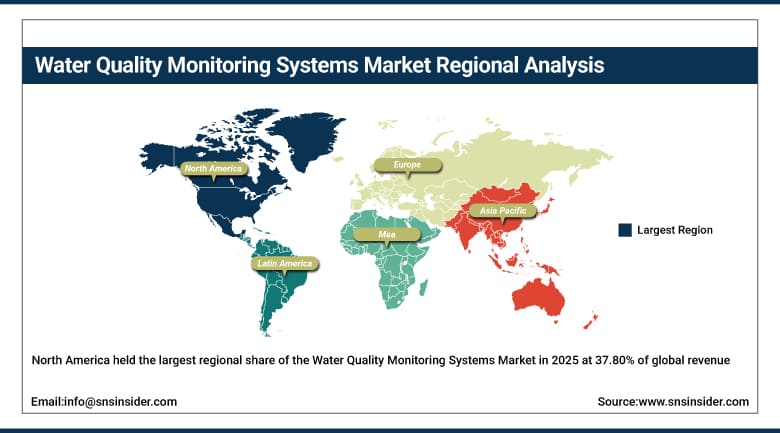
North America held the largest regional share of the Water Quality Monitoring Systems Market in 2025 at 37.80% of global revenue, underpinned by stringent EPA drinking-water and effluent regulations, a mature installed base of municipal and industrial monitoring infrastructure, and substantial federal investment in water infrastructure modernization. The region benefits from a dense concentration of leading instrumentation manufacturers, including several headquartered directly within the United States, which shortens technology adoption cycles and supports rapid rollout of next-generation sensors and analytics platforms. Growing public concern over PFAS contamination, lead service line replacement, and harmful algal blooms has further pushed both regulators and utilities to expand monitoring coverage well beyond baseline compliance requirements.
The United States accounted for approximately 84.60% of the North American market in 2025, reflecting its large installed base of water utilities, extensive industrial water use across chemicals, semiconductors, and food processing, and the scale of federal infrastructure funding directed at water systems. Canada is contributing to regional growth through provincial investments in wastewater treatment upgrades and expanding indigenous community water-safety programs, which are extending continuous monitoring into previously underserved rural and remote areas.
Get Customized Report as Per Your Business Requirement - Enquiry Now
Europe Water Quality Monitoring Systems Market Insights
Europe is expected to have accounted for a substantial regional market share in 2025 on the back of the EU Water Framework Directive, Drinking Water Directive revision, and stricter industrial discharge regulations that necessitate continual proof of compliance, rather than intermittent testing only. Moreover, increasing funding for circular water reuse and desalination initiatives in water stressed Mediterranean countries is adding to the overall addressable market size for monitoring systems which can monitor more chemical and biological variables.
Germany was the leading regional market player in Europe with 24.80% market share in 2025. This is attributed to its large industrial sector, advanced manufacturing industry, and developed municipal utility network that is investing in digitalized water management. The UK, France, and Netherlands are also significantly contributing towards regional growth as utilities in these countries are rapidly deploying smart water networks and sensor-based leak and contamination detection systems under their respective infrastructure resilience initiatives.
Asia Pacific Water Quality Monitoring Systems Market Insights
Asia Pacific is projected to register the fastest CAGR of 9.65% during the forecast period 2026-2035, driven by rapid urbanization, expanding industrial water use, and large-scale government investment in water infrastructure across China, India, and Southeast Asia. Rising public health awareness following documented water contamination incidents, combined with expanding regulatory frameworks modeled on Western standards, is pushing both governments and private industry to adopt continuous monitoring at a pace that outstrips more mature regions.
China accounted for approximately 48.30% of the Asia Pacific market in 2025, supported by aggressive national water-pollution control initiatives, large-scale wastewater treatment capacity expansion, and a rapidly growing domestic instrumentation manufacturing base that is lowering equipment costs across the region. Japan, South Korea, and India are also expanding their contributions to regional growth through smart-city water infrastructure programs, semiconductor-industry process water monitoring, and government-led river and groundwater surveillance initiatives.
Middle East & Africa and Latin America Water Quality Monitoring Systems Market Insights
The Middle East & Africa and Latin America markets are at an early stage of market development but have shown steady growth due to an increase in capacity of desalination, increasing diversity in industries, and focus on water security by the government amidst growing concerns regarding scarcity. In particular, countries in the Middle East are incorporating advanced water quality monitoring in large-scale desalination and reuse facilities due to the sensitivity of such systems to variations in feedwater quality.
In 2025, Saudi Arabia led the Middle East & Africa market accounting for 31.20% of the regional market owing to national water security policies as well as investments in desalination and wastewater reuse infrastructure. Similarly, the UAE is focusing on intelligent water network infrastructure that fits into its digital infrastructure initiative. In Latin America, 39.70% of the regional market was accounted for by Brazil owing to the growth in municipal wastewater treatment and increasing industrial water regulations, with Mexico and Colombia also showing contributions to the growth of the region.
Market Dynamics:
Growth Drivers: Tightening Regulatory Standards and Rising Contamination Concerns Driving Market Growth
The Water Quality Monitoring Systems Market is being driven primarily by intensifying regulatory scrutiny of drinking water and industrial effluent quality, growing public awareness of emerging contaminants such as PFAS and microplastics, and the accelerating digital transformation of municipal utility operations. Regulatory bodies worldwide are progressively lowering permissible contamination thresholds and expanding the list of parameters that must be continuously monitored and reported, converting what was once periodic compliance testing into a standing operational requirement for real-time instrumentation. Aging water infrastructure across developed economies is compounding this pressure, as utilities replacing decades-old pipes and treatment assets increasingly specify integrated digital monitoring as part of broader modernization projects rather than treating it as a separate line item.
Falling costs of sensors, wireless telemetry, and cloud computing are also expanding the addressable market beyond large utilities to include smaller municipalities, aquaculture operators, and agricultural users who previously could not justify the capital expense of continuous monitoring. Growing industrial adoption is being reinforced by corporate sustainability commitments, which increasingly require companies to demonstrate measurable water stewardship performance to investors and regulators alike. The convergence of IoT connectivity, AI-based anomaly detection, and cloud analytics is further increasing the value proposition of modern monitoring systems by transforming raw sensor readings into actionable operational intelligence, a capability that is becoming a genuine competitive differentiator for treatment plant operators seeking to reduce chemical dosing costs and prevent compliance violations before they occur.
Restraints: High Capital Costs and Sensor Maintenance Complexity Limiting Broader Adoption
Even with high demand levels, there are quite a number of factors restraining the growth of the market due to the capital intensiveness of the monitoring networks and operations in maintaining sensor reliability. The use of multiparameter sondes, optical analyzers, and telemetry networks involves high initial costs that are not easily justifiable by small municipalities, utilities in developing economies, and cost-conscious industries, given the current weak regulation. Fouling of sensors, biofilm formation, and drifts in calibration are recurrent problems with the sensors, especially in nutrient-enriched wastewaters and warm coastal waters, and this calls for either regular visits to service the sensors or purchase of expensive self-cleaning and self-calibrating sensors.
One of the other constraints is the inadequate number of qualified technicians to install, calibrate, and manage the operation of the complex sensors. This is more challenging in developing economies due to the fact that the training of technicians has not progressed at the same rate as the deployment of equipment. Data management has become an increasing issue since any utility that uses dense sensors needs to make significant investments in cybersecurity, storage facilities, and analytics capabilities in order to gain benefit out of the collected data.
Opportunities: Smart Water Infrastructure and Emerging-Market Expansion Creating New Growth Avenues
Substantial opportunity exists in the ongoing global transition toward smart water infrastructure, where continuous monitoring is being integrated with predictive maintenance, automated treatment control, and non-revenue-water reduction programs to deliver measurable operational savings alongside compliance benefits. Utilities that successfully demonstrate return on investment through reduced chemical usage, fewer compliance violations, and lower emergency response costs are creating a compelling business case that is likely to accelerate adoption well beyond regulatory minimums over the coming decade.
Emerging economies across Asia Pacific, Latin America, and the Middle East & Africa represent a particularly significant growth avenue, as governments in these regions prioritize water security investment amid growing population pressure and climate-driven scarcity concerns. The expansion of low-cost, ruggedized sensor technology is making continuous monitoring economically viable in previously underserved rural and peri-urban areas, while growing interest from development finance institutions in funding water infrastructure projects is likely to further accelerate deployment. Additional opportunity is emerging in adjacent applications such as aquaculture, precision agriculture irrigation management, and climate-related watershed monitoring, all of which are expanding the addressable market well beyond traditional municipal and industrial use cases.
Recent Developments:
-
2026: Xylem Inc. completed its acquisition of TriOS Mess- und Datentechnik GmbH, a German optical sensing specialist, expanding its UV-Vis spectrometry portfolio for real-time nutrient, organic pollutant, and turbidity detection across municipal, industrial, and marine water quality applications.
-
2026: SWAN Analytical Instruments launched the AMI-II Fluotrace Oil analyzer, a reagent-free, nano-coated optical monitor for real-time oil-in-water detection, targeting power generation, desalination, marine ballast water, and industrial cooling water applications.
-
2025: Endress+Hauser expanded its Liquiline digital sensor platform with a dedicated aquaculture monitoring suite for continuous dissolved oxygen, ammonia, and pH tracking, building on deployments at European fish-farming operations such as Aqualande.
-
2025: Veralto's Hach business introduced an AI-enabled real-time contaminant screening platform designed to flag PFAS and other emerging micropollutants in municipal drinking water networks ahead of finalized U.S. EPA compliance deadlines.
Water Quality Monitoring Systems Companies are:
-
Xylem Inc.
-
Danaher Corporation (Hach / Veralto)
-
ABB Ltd.
-
Emerson Electric Co.
-
Thermo Fisher Scientific Inc.
-
Honeywell International Inc.
-
Endress+Hauser Group Services AG
-
HORIBA Ltd.
-
Metrohm AG
-
Veolia Water Technologies
-
Teledyne Technologies Incorporated
-
Agilent Technologies Inc.
-
Siemens AG
-
In-Situ Inc.
-
OTT HydroMet GmbH
-
Myron L Company
-
SWAN Analytical Instruments AG
Water Quality Monitoring Systems Market Report Scope:
| Report Attributes | Details |
|---|---|
| Market Size in 2025 | USD 6.10 Billion |
| Market Size by 2035 | USD 12.75 Billion |
| CAGR | CAGR of 7.65% From 2026 to 2035 |
| Base Year | 2025 |
| Forecast Period | 2026-2035 |
| Historical Data | 2022-2024 |
| Report Scope & Coverage | Market Size, Segments Analysis, Competitive Landscape, Regional Analysis, DROC & SWOT Analysis, Forecast Outlook |
| Key Segments | • by Component (Sensors & Probes, Analyzers, Data Acquisition & Transmission Systems, Software & Data Management Platforms, Sampling Systems & Accessories) • by Technology (Online/Continuous Monitoring, Portable/Handheld Monitoring, Laboratory-Based Monitoring) • by Application (Drinking Water Treatment, Wastewater Treatment, Industrial Process Water, Environmental & Surface Water Monitoring, Aquaculture & Marine Monitoring, Groundwater Monitoring) • by End User (Municipal Utilities, Industrial, Commercial, Residential, Government & Environmental Agencies) • by Deployment Mode (On-Premises, Cloud-Based/Remote Monitoring) |
| Regional Analysis/Coverage | North America (US, Canada, Mexico), Europe (Eastern Europe [Poland, Romania, Hungary, Turkey, Rest of Eastern Europe] Western Europe] Germany, France, UK, Italy, Spain, Netherlands, Switzerland, Austria, Rest of Western Europe]), Asia Pacific (China, India, Japan, South Korea, Vietnam, Singapore, Australia, Rest of Asia Pacific), Middle East & Africa (Middle East [UAE, Egypt, Saudi Arabia, Qatar, Rest of Middle East], Africa [Nigeria, South Africa, Rest of Africa], Latin America (Brazil, Argentina, Colombia, Rest of Latin America) |
| Company Profiles | Xylem Inc., Danaher Corporation (Hach / Veralto), ABB Ltd., Emerson Electric Co., Thermo Fisher Scientific Inc., Honeywell International Inc., Endress+Hauser Group Services AG, Yokogawa Electric Corporation, HORIBA Ltd., Metrohm AG, Veolia Water Technologies, Teledyne Technologies Incorporated, Agilent Technologies Inc., Siemens AG, In-Situ Inc., OTT HydroMet GmbH, Myron L Company, SWAN Analytical Instruments AG |
Frequently Asked Questions
The Water Quality Monitoring Systems Market is expected to grow at a CAGR of 7.65% from 2026 to 2035.
The Water Quality Monitoring Systems Market was valued at USD 6.10 Billion in 2025.
The market is driven by tightening drinking-water and effluent regulations, rising concern over emerging contaminants such as PFAS, growing adoption of IoT-enabled continuous monitoring, and expanding smart water infrastructure investment.
The Sensors & Probes segment dominated the Water Quality Monitoring Systems Market in 2025, accounting for approximately 34.20% market share.
The North America region dominated the Water Quality Monitoring Systems Market in 2025, accounting for approximately 37.80% market share.
