
Telehealth and Telemedicine Market Report Scope & Overview:
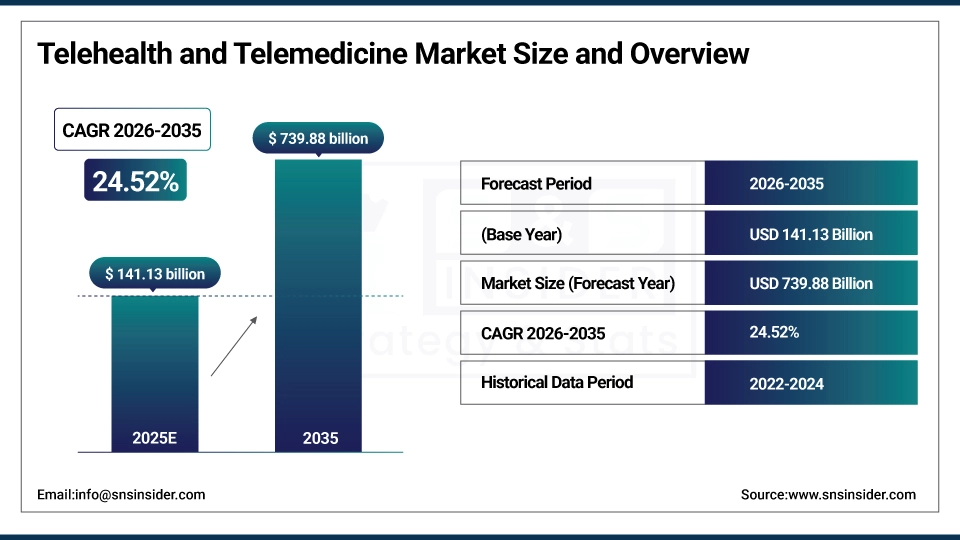
The Telehealth and Telemedicine Market size is estimated at USD 141.13 billion in 2025 and is expected to reach USD 739.88 billion by 2035, growing at a CAGR of 24.52% over the forecast period of 2026-2035.
The global telehealth and telemedicine market trend is a growing demand for remote healthcare delivery solutions such as virtual consultation platforms, remote patient monitoring systems, and digital health applications as the growth of the market is driven by increasing smartphone penetration, government initiatives for healthcare digitalization, and patient demand for convenient access to medical services. This trend is also driven by a growing adoption of value-based care models and the growing focus on reducing healthcare costs as healthcare providers become more focused on improving accessibility and are more willing to invest in virtual care technologies, resulting in growth in the domestic and international market for cloud-based and on-premise telemedicine solutions.
For instance, in March 2024, growing awareness and improved digital infrastructure drove a 34% increase in telehealth platform adoption for healthcare systems globally, boosting remote consultation services and virtual care delivery capabilities.
To Get more information on Telehealth and Telemedicine Market - Request Free Sample Report
Telehealth and Telemedicine Market Trends
-
Telehealth and telemedicine solutions are being adopted because patients demand immediate access to healthcare services, virtual consultations, and remote monitoring capabilities.
-
Customized virtual care platforms based on specialty requirements, patient demographics, and chronic disease management to improve healthcare delivery outcomes.
-
The development of AI-powered diagnostic tools, wearable device integration, and blockchain-based health record systems to improve the accuracy of remote diagnosis and reduce healthcare access barriers.
-
Secure video conferencing systems, mobile health applications, and IoT-enabled medical devices are all available to ensure continuous patient engagement and treatment adherence.
-
Increased demand for cloud-based platforms, 5G network integration and interoperable health information systems to help real-time data exchange and clinical decision support.
-
Collaboration between healthcare providers, technology companies and telecom operators to develop integrated telemedicine ecosystems and improve service delivery standards.
-
CMS, FDA and state licensing boards promoting standards for telehealth reimbursement, interstate licensure compacts, and virtual care quality metrics.
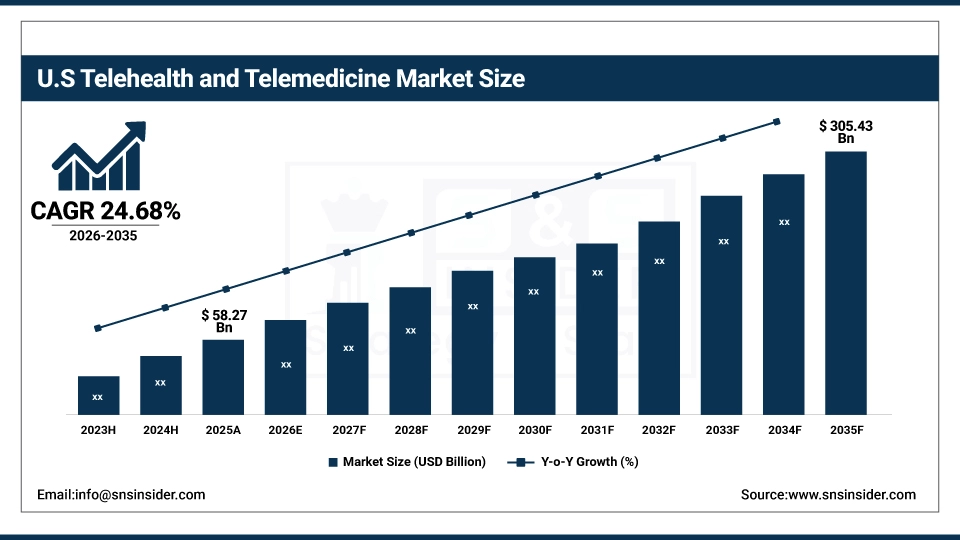
The U.S. Telehealth and Telemedicine Market is estimated at USD 58.27 billion in 2025 and is expected to reach USD 305.43 billion by 2035, growing at a CAGR of 24.68% from 2026-2035. The United States represents the largest market for telehealth and telemedicine, primarily driven by the widespread broadband infrastructure, federal reimbursement policies for virtual care, and well-developed healthcare technology ecosystem. Government initiatives, high levels of health insurance coverage for telemedicine services and increased investment in digital health platforms from healthcare providers help to drive growth in the market. Also, the U.S. is the largest regional market in the world, due to the regulatory support and swift adoption of cloud-based and mobile-enabled virtual care solutions.
Telehealth and Telemedicine Market Growth Drivers:
-
Rising Chronic Disease Prevalence and Healthcare Access Gaps are Driving the Telehealth and Telemedicine Market Growth
Rising chronic disease prevalence and healthcare access gaps take the center stage as a growth driver for the telehealth and telemedicine market share, and are driven by the implementation of remote patient monitoring programs, chronic care management platforms, and rural health initiatives for increased healthcare accessibility and continuous disease management. These solutions for population health improvement and care coordination are driving the base of the market, the penetration of cloud-based & mobile-first markets, and adding to the overall market share globally.
For instance, in June 2024, cloud-based and AI-integrated telehealth solutions accounted for ~71% of the total global healthcare technology investments, reflecting growing institutional preference and expanding market share.
Telehealth and Telemedicine Market Restraints:
-
Data Privacy Concerns and Regulatory Compliance Challenges are Hampering the Telehealth and Telemedicine Market Growth
Data privacy concerns & regulatory compliance challenges of telehealth platforms also restrict the telehealth and telemedicine market growth, as a large number of healthcare providers face difficulties navigating varying state licensing requirements, reimbursement policies, and patient data protection regulations. This might lead to implementation delays, limited service expansion, and reduced provider confidence in adopting virtual care technologies. As a result, patient access suffers, and market growth is stunted in regions where regulatory frameworks are fragmented and cybersecurity infrastructure is inadequate.
Telehealth and Telemedicine Market Opportunities:
-
5G Network Deployment and IoT Integration Drive Future Growth Opportunities for the Telehealth and Telemedicine Market
The opportunity in the 5G network deployment and IoT integration in telehealth and telemedicine market is in the form of ultra-low latency video consultations, real-time remote surgery capabilities, and continuous health monitoring through connected devices. These solutions provide for enhanced diagnostic accuracy, individualized treatment recommendations, and seamless data transmission across healthcare networks. Through improved clinical outcomes, enhanced patient engagement, and operational efficiency, particularly in areas with advanced telecommunications infrastructure, these technologies may improve access to specialist care, decrease hospital readmissions, and expand the market.
For instance, in April 2024, the WHO reported that 78% of global healthcare organizations expanded their telehealth capabilities, highlighting rising platform adoption and increasing demand for virtual care delivery systems.
Telehealth and Telemedicine Market Segment Analysis
-
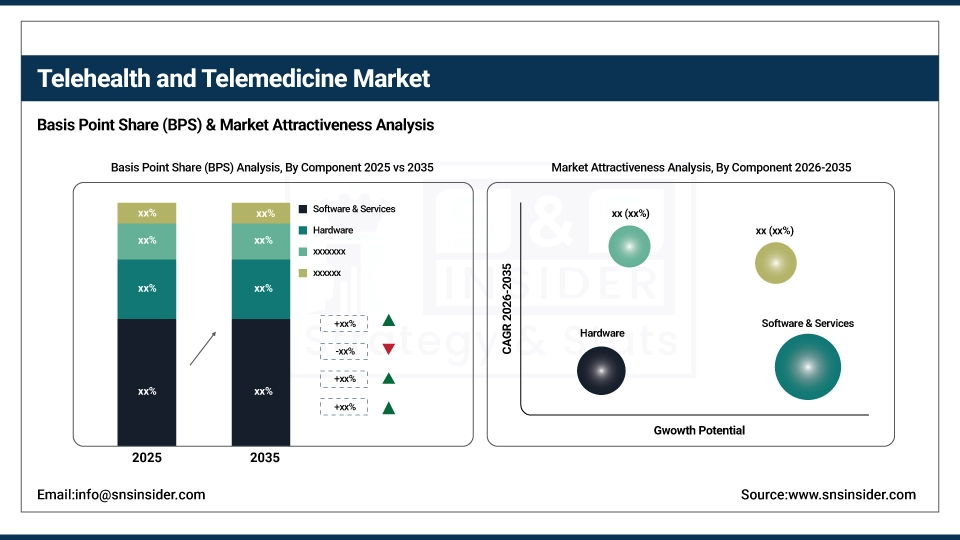
By component, software & services held the largest share of around 67.82% in 2025E, and the hardware segment is expected to register the highest growth with a CAGR of 25.34%.
-
By mode of delivery, the cloud-based segment dominated the market with approximately 64.56% share in 2025E, while the on-premise is expected to register the highest growth with a CAGR of 25.18%.
-
By end user, providers accounted for the leading share of nearly 58.94% in 2025E, and is expected to register the highest growth with a CAGR of 24.87%.
By Component, Software & Services Leads the Market, While Hardware Registers Fastest Growth
The software & services segment accounted for the highest revenue share of approximately 67.82% in 2025, owing to growing demand for telemedicine platforms, virtual consultation applications, and subscription-based service models. Emerging trends, including increasing requirements for integrated health information systems and regulatory emphasis on interoperability standards. In comparison, the hardware segment is anticipated to achieve the highest CAGR of nearly 25.34% during the 2026–2035 period, driven by the increasing deployment of remote monitoring devices, diagnostic equipment with connectivity features, and wearable health technology. Drivers include rising adoption of IoT-enabled medical devices, the preference for home-based healthcare solutions.
By Mode of Delivery, the Cloud-Based Segment dominates, while the On-Premise Segment Shows Rapid Growth
By 2025, the cloud-based segment contributed the largest revenue share of 64.56% due to its scalability advantages, reduced infrastructure costs and seamless software updates. Growing adoption of Software-as-a-Service delivery models coupled with improved data security protocols, providers are increasingly preferring cloud-hosted telehealth platforms. The on-premise segment is projected to grow at the highest CAGR of about 25.18% between 2026 and 2035 due to the growing need for enhanced data control and compliance with stringent privacy regulations. Some of the reasons include better integration with existing hospital information systems, improved data sovereignty for large healthcare institutions, and healthcare organizations' preference for maintaining complete control over patient health information.
By End User, Providers Lead, and Registers Fastest Growth
The providers segment accounted for the largest share of the telehealth and telemedicine market with about 58.94%, owing to their direct patient care responsibilities, revenue optimization opportunities, and capacity to implement comprehensive virtual care programs. Reasons driving the healthcare provider segment include increasing patient volume management needs and specialty care delivery expansion. In addition, it is slated to grow at the fastest rate with a CAGR of around 24.87% throughout the forecast period of 2026–2035, as hospitals, clinics, and physician practices seek integrated telemedicine platforms, virtual consultation capabilities, and remote patient monitoring solutions. Increased focus on care accessibility and convenience contribute to their adoption, while improved patient satisfaction scores and reduced overhead costs drive continued investment.
Telehealth and Telemedicine Market Regional Highlights:
North America Telehealth and Telemedicine Market Insights:
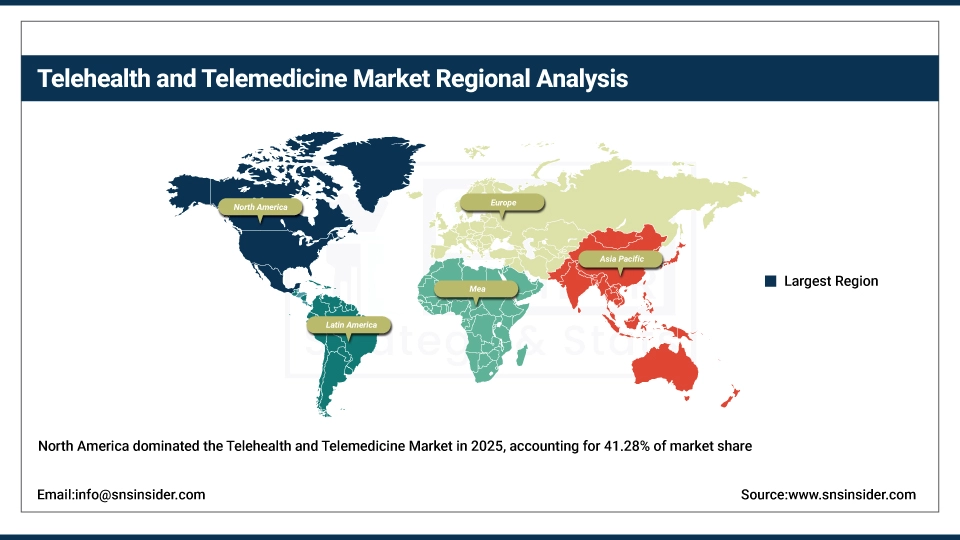
North America held the largest revenue share of over 41.28% in 2025 of the telehealth and telemedicine market due to an established healthcare IT environment, comprehensive reimbursement policies for virtual care, and increased consumer awareness regarding the benefits of telehealth services. Drivers include ubiquitous use of electronic health records, an advanced broadband network, growing smartphone penetration and greater acceptance of virtual consultations stemming from pandemic-driven behavioral changes. At the same time, various government incentives, Medicare and Medicaid telehealth coverage expansion and enormous investments in digital health technology from healthcare providers and insurers are anchoring telemedicine software and services in the market, and ensuring multibillion dollar revenues around the world.
Get Customized Report as per Your Business Requirement - Enquiry Now
Asia Pacific Telehealth and Telemedicine Market Insights:
Asia Pacific is the fastest-growing segment in the telehealth and telemedicine market with a CAGR of 26.78%, as the awareness about virtual healthcare services, government digital health initiatives, and mobile internet penetration in developing nations is growing. Factors including rapid urbanization, rising middle-class population with health insurance coverage, and growing uptake of smartphone-based health applications are stimulating the market growth. Mobile health program implementation and telemedicine policy frameworks have been instrumental in improving healthcare access, especially in rural or underserved settings. Public-private partnerships and technology infrastructure investments also help in advancing virtual care delivery and digital health transformation. Increase in demand in Asia Pacific region owing to rising healthcare expenditure against historical spending levels and growing affordability and accessibility of cloud-based telemedicine platforms.
Europe Telehealth and Telemedicine Market Insights:
The telehealth and telemedicine market in Europe is the second-dominating region after North America on account of an increase in the adoption of national telemedicine strategies, robust data protection regulations including GDPR, and increasing patient empowerment initiatives across healthcare systems. Rising implementation of cross-border telehealth services, advanced digital health infrastructure, favorable government funding for virtual care projects, and European health data space initiatives are also contributing to the sustained growth of the market in leading European countries.
Latin America (LATAM) and Middle East & Africa (MEA) Telehealth and Telemedicine Market Insights:
In Latin America, and Middle East & Africa, the growing healthcare digitization efforts and increase in mobile connectivity with affordable smartphone availability support the telehealth and telemedicine market growth. The rising popularity of cost-effective telemedicine solutions and multilingual platform capabilities, along with international healthcare organization partnerships, will aid healthcare accessibility and chronic disease management. The increasing young population and improving telecommunications infrastructure in these regions are continuing to encourage market growth.
Telehealth and Telemedicine Market Competitive Landscape:
Teladoc Health, Inc. (est. 2002) is a leading virtual care provider that focuses on integrated telehealth services for comprehensive healthcare delivery. It uses its extensive provider network and advanced technology platform to produce cutting-edge telemedicine solutions with seamless patient engagement and clinical excellence integration.
-
In February 2025, it expanded its AI-powered chronic care management capabilities with integrated mental health services and remote monitoring features, aiming to improve patient outcomes and expand access to specialty care across its global platform.
Amwell (American Well Corporation) (est. 2006) is a well-known global telehealth technology company focused on digital care delivery platforms, care coordination solutions, and virtual care enablement. It invests in interoperable telemedicine platforms and white-label telehealth applications with the hopes of revolutionizing healthcare access with secure, scalable, and provider-friendly virtual care tools.
-
In May 2024, launched an enhanced telehealth platform featuring AI-driven clinical decision support and integrated pharmacy services across healthcare systems, enhancing diagnostic accuracy, treatment adherence, and virtual care convenience.
MDLIVE Inc. (est. 2009) is a leading on-demand telehealth provider in the fields of urgent care services, behavioral health support, and chronic condition management. The company's telemedicine product portfolio focuses on consumer-centric interfaces and multi-specialty care access, and features a strong commitment to quality assurance and continuous innovation to complement the strong market presence in both employer-sponsored and direct-to-consumer settings.
-
In September 2024, introduced advanced remote patient monitoring and predictive analytics features for its virtual care platform, strengthening chronic disease management capabilities and expanding adoption among health plans and employer groups.
Telehealth and Telemedicine Market Key Players:
-
Teladoc Health, Inc.
-
Amwell (American Well Corporation)
-
MDLIVE Inc.
-
Doctor On Demand, Inc.
-
GE Healthcare
-
Philips Healthcare
-
Medtronic plc
-
BioTelemetry, Inc. (Philips)
-
InTouch Health (Teladoc Health)
-
VSee Lab, Inc.
-
Cisco Systems, Inc.
-
GlobalMed
-
AMD Global Telemedicine
-
Honeywell Life Care Solutions
-
SOC Telemed
-
Zipnosis, Inc.
-
Hims & Hers Health, Inc.
-
98point6 Inc.
-
PlushCare (Accolade, Inc.)
-
Babylon Health
-
Ping An Healthcare and Technology Company Limited
-
KRY International AB (Livi)
-
Doxy.me
-
Updox
-
Chiron Health
| Report Attributes | Details |
|---|---|
| Market Size in 2025 | USD 141.13 Billion |
| Market Size by 2035 | USD 739.88 Billion |
| CAGR | CAGR of 24.52% From 2026 to 2035 |
| Base Year | 2025 |
| Forecast Period | 2026-2035 |
| Historical Data | 2022-2024 |
| Report Scope & Coverage | Market Size, Segments Analysis, Competitive Landscape, Regional Analysis, DROC & SWOT Analysis, Forecast Outlook |
| Key Segments | • By Component (Software & Services, Hardware) • By Mode of Delivery (Cloud-based, On-premise) • By Application (Teleconsultation, TeleICU, Telestroke, Teleradiology, Telepsychiatry, Teledermatology, Other) • By End User (Providers, Payers, Patients, Other) |
| Regional Analysis/Coverage | North America (US, Canada, Mexico), Europe (Eastern Europe [Poland, Romania, Hungary, Turkey, Rest of Eastern Europe] Western Europe] Germany, France, UK, Italy, Spain, Netherlands, Switzerland, Austria, Rest of Western Europe]), Asia Pacific (China, India, Japan, South Korea, Vietnam, Singapore, Australia, Rest of Asia Pacific), Middle East & Africa (Middle East [UAE, Egypt, Saudi Arabia, Qatar, Rest of Middle East], Africa [Nigeria, South Africa, Rest of Africa], Latin America (Brazil, Argentina, Colombia, Rest of Latin America) |
| Company Profiles | Teladoc Health, Inc., Amwell (American Well Corporation), MDLIVE Inc., Doctor On Demand, Inc., GE Healthcare, Philips Healthcare, Medtronic plc, BioTelemetry, Inc. (Philips), InTouch Health (Teladoc Health), VSee Lab, Inc., Cisco Systems, Inc., GlobalMed, AMD Global Telemedicine, Honeywell Life Care Solutions, SOC Telemed, Zipnosis, Inc., Hims & Hers Health, Inc., 98point6 Inc., PlushCare (Accolade, Inc.), Babylon Health, Ping An Healthcare and Technology Company Limited, KRY International AB (Livi), Doxy.me, Updox, Chiron Health |

Frequently Asked Questions
Ans: The Telehealth and Telemedicine Market was valued at USD 101.32 Billion in 2023.
Ans: The expected CAGR of the Global Telehealth and Telemedicine Market during the forecast period is 24.52%
Ans: Providers held the largest share in the Telehealth and Telemedicine Market in 2023.
Ans: The Telehealth and Telemedicine Market will be valued at USD 659.65 Billion in 2032.
Ans: The U.S. led Telehealth and Telemedicine in the North American region with the highest revenue share in 2023.
