
Healthcare Middleware Market Report Scope & Overview:
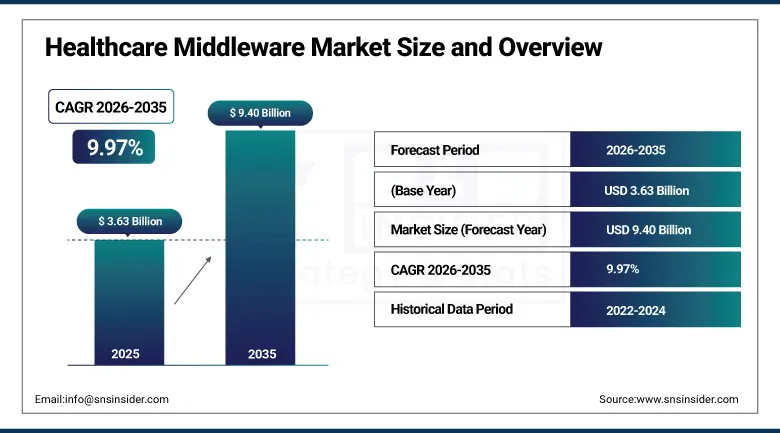
The Healthcare Middleware Market was valued at USD 3.63 Billion in 2025 and is expected to reach USD 9.40 Billion by 2035, growing at a CAGR of 9.97% from 2026–2035.
The global healthcare middleware market is growing at a sustained and commercially significant pace. Healthcare middleware refers to software infrastructure that bridges the communication gap between disparate healthcare IT systems enabling standardized, secure, and real-time data exchange across complex multi-vendor healthcare IT environments. The market is growing rapidly due to the rising need for seamless interoperability, data integration, and real-time analytics in healthcare IT, with middleware solutions enabling smooth communication between EHR, billing systems, and clinical applications. Key growth drivers include regulatory mandates, value-based healthcare adoption, and increasing digitalization, while cloud-based solutions, AI, and big data analytics further propel the market.
In April 2023, InterSystems launched HealthShare Health Connect Cloud, a cloud-based healthcare middleware platform designed to enhance data interoperability by enabling healthcare organisations to connect diverse systems and applications across their enterprises, ensuring seamless data exchange and improved care coordination. The cloud deployment eliminates the on-premise installation and maintenance burden that previously created adoption barriers for smaller health systems and community hospitals whose limited IT infrastructure creates cloud-native middleware specification motivation.
Market Size and Forecast
-
Market Size in 2026E: USD 3.99 Billion
-
Market Size by 2035: USD 9.40 Billion
-
CAGR: 9.97% from 2026 to 2035
-
Fastest Growing Region: Asia Pacific
-
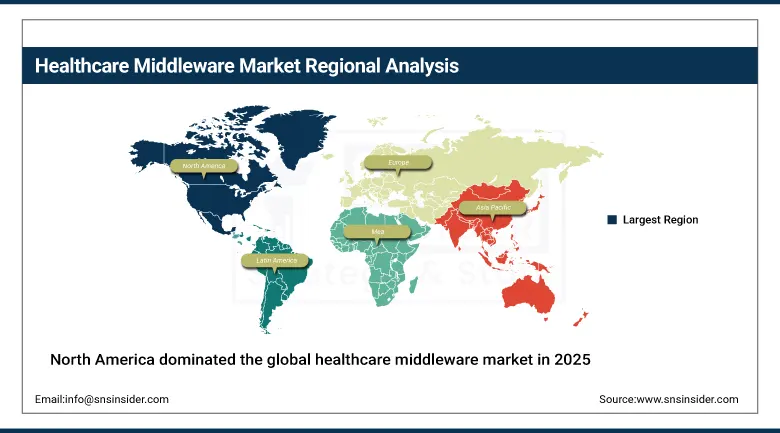
Largest Region: North America
To Get more information On Healthcare Middleware Market - Request Free Sample Report
Healthcare Middleware Market Trends
-
HL7 FHIR API adoption is accelerating healthcare data interoperability and enabling seamless third-party application integration.
-
AI-powered middleware improves data routing, anomaly detection, and clinical workflow efficiency across connected healthcare systems.
-
Regulatory interoperability mandates are driving healthcare organizations to invest in compliant middleware integration platforms.
-
Expanding EHR API ecosystems create new opportunities for middleware providers to deliver value-added integration services.
-
Growing adoption of connected medical devices increases demand for middleware supporting real-time healthcare data exchange.
The U.S. Healthcare Middleware Market Outlook
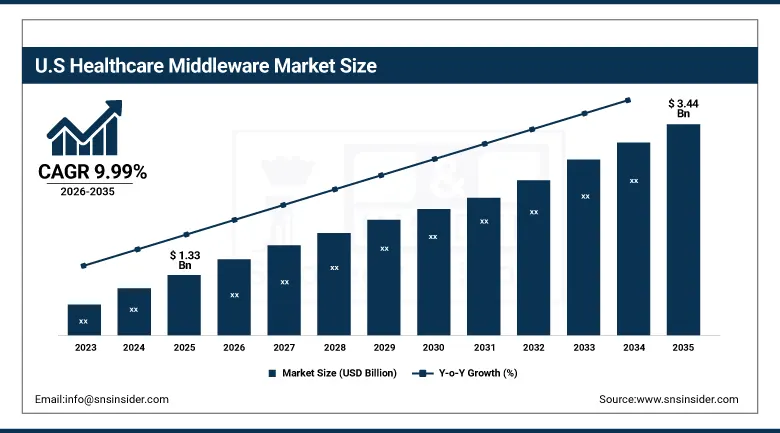
The U.S. Healthcare Middleware Market was valued at approximately USD 1.33 Billion in 2025 and is expected to reach approximately USD 3.44 Billion by 2035, growing at a CAGR of approximately 9.99%.
The U.S. is the most commercially significant healthcare middleware market within North America’s dominant position. InterSystems, MuleSoft (Salesforce), IBM Watson Health, Microsoft Azure Health Data Services, and Oracle Health’s middleware portfolio collectively define the domestic healthcare middleware commercial landscape. ONC’s 21st Century Cures Act’s information blocking prohibition, CMS’ Interoperability Rule’s FHIR API mandate, and HIPAA’s protected health information security standards create the most commercially comprehensive regulatory framework for healthcare middleware adoption globally.
In 2024, Microsoft expanded its Azure Health Data Services platform with new FHIR R4 bulk data access, DICOM service enhancements, and MedTech service for IoT medical device data integration, creating a comprehensive cloud-based healthcare middleware ecosystem that enables health systems to consolidate EHR, imaging, device, and analytics data in a unified FHIR-compliant data store. The expansion reflects the commercial recognition that cloud-native FHIR-based middleware creates the foundation for AI-powered clinical analytics whose downstream value sustains premium Azure Health Data Services adoption.
Healthcare Middleware Market Segment Analysis
-
By Type, the platform middleware segment dominated the market with 39% share in 2025, while the integration middleware segment is set to experience the largest CAGR of 10.9%.
-
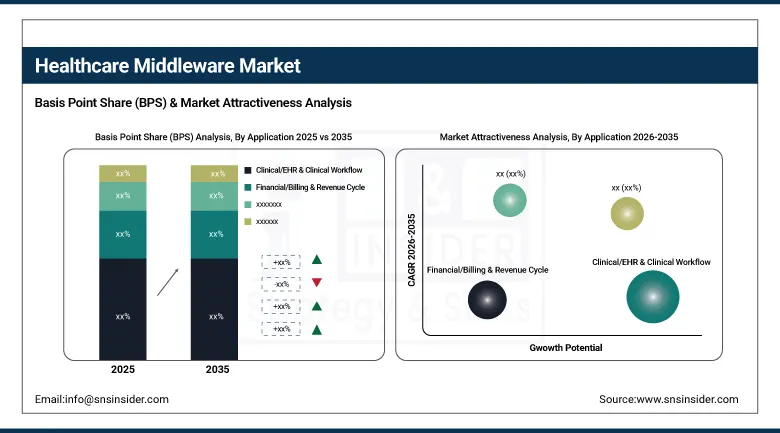
By Application, the clinical segment dominated the market with 47% share in 2025, while the financial segment is expected to grow at the largest CAGR of 11.0%.
-
By End User, the healthcare providers segment dominated the market with 53% share in 2025, while the healthcare payers segment is the fastest growing.
-
By Deployment Mode, the cloud-based segment dominated the market with approximately 55% share in 2025, while the on-premise segment retains significant share.
By Type, platform middleware dominates, integration middleware grows fastest
Platform middleware retained the dominant type position with 39% of the healthcare middleware market in 2025. Platform middleware’s commercial primacy reflects its foundational role as the application server, database middleware, and web portal infrastructure layer whose enabling capability is prerequisite for all healthcare application deployment and clinical workflow support. Each hospital’s Epic, Cerner, or Meditech EHR deployment creates platform middleware procurement whose application server infrastructure, database connection pooling, and web service hosting create consistent commercial demand. The healthcare IT system’s progressive migration from client-server to web-based and cloud-native architecture creates platform middleware upgrade procurement whose modernization investment sustains commercial relationships with platform middleware vendors.
Integration middleware is the fastest-growing type at 10.9% CAGR because the healthcare sector’s extraordinary IT system diversity creates growing demand for Enterprise Service Bus, API management, and HL7 FHIR gateway solutions. Each new healthcare system merger that creates multi-EHR integration challenge creates integration middleware procurement whose complexity sustains premium commercial relationships with specialized healthcare integration vendors. The CMS FHIR mandate’s regulatory deadline creates non-discretionary integration middleware investment that compounds with voluntary interoperability improvement motivation.
By Application, clinical dominates, financial grows fastest
Clinical applications retained the dominant application position with 47% of the healthcare middleware market in 2025. Clinical’s commercial primacy reflects the foundational role of EHR integration, order management, clinical decision support, and care coordination in the modern healthcare IT environment whose patient safety and clinical quality motivation creates consistent procurement. Each clinical workflow that requires result delivery from laboratory to EHR, order transmission from physician to pharmacy, and alert routing from monitoring system to nursing station creates clinical middleware procurement whose patient safety character creates investment motivation beyond pure economic ROI.
Financial middleware is the fastest-growing application at 11.0% CAGR because the healthcare reimbursement system’s progressive complexity, encompassing value-based care contract administration, alternative payment model reporting, and claims adjudication automation, creates growing demand for financial integration middleware whose revenue cycle management, billing accuracy, and fraud detection capability creates measurable financial ROI. Each value-based care contract that creates quality measurement, cost reporting, and performance-based payment administration creates financial middleware procurement whose complexity compounds with each new alternative payment model adoption.
By End User, providers dominate, payers grow fastest
Healthcare providers retained the dominant end-user position with 53% of the healthcare middleware market in 2025. Hospital and health system’s comprehensive middleware deployment across EHR integration, clinical application connectivity, billing system interface, and diagnostic system communication creates the most commercially concentrated healthcare middleware procurement. Each health system’s IT environment whose 50-200 discrete application systems create thousands of point-to-point integration interfaces creates middleware investment motivation whose centralized integration platform economics create commercial ROI. The hospital’s patient safety motivation for real-time clinical data availability, whose middleware-enabled delivery creates outcome improvement that regulatory and accreditation requirements sustain, creates non-discretionary procurement.
Healthcare payers are the fastest-growing end user because insurance companies and health plan administrators’ progressive transition to value-based reimbursement creates integration complexity whose clinical and financial data exchange requirements create middleware procurement growth. Each health plan’s HEDIS quality measure reporting, risk adjustment data submission, and prior authorization integration creates payer middleware demand whose regulatory compliance and network management motivation sustains investment. The CMS Interoperability Rule’s payer obligation for FHIR-based patient data access creates non-discretionary payer middleware adoption that compounds with voluntary interoperability improvement motivation.
Regional Analysis
|
Region |
Major Country |
Share within Region, 2025 (%) |
|---|---|---|
|
North America |
United States |
87.4% |
|
Europe |
Germany |
22.3% |
|
Asia Pacific |
China |
44.8% |
|
Middle East & Africa |
Saudi Arabia |
31.2% |
|
Latin America |
Brazil |
44.2% |
North America Healthcare Middleware Market Insights
North America dominated the global healthcare middleware market in 2025 with the highest revenue share, driven by the most commercially advanced healthcare IT ecosystem, comprehensive regulatory framework, and above-average health system IT spending. The United States accounts for approximately 87.4% of North American revenues through InterSystems, MuleSoft, IBM, Microsoft, and Oracle Health’s commercial operations sustained by the ONC and CMS regulatory mandate creating non-discretionary middleware adoption.
Canada contributes approximately 12.6% of North American revenues through its provincial health system’s EHR integration programme, the growing digital health investment, and PIPEDA’s health data privacy compliance creating middleware security investment.
Get Customized Report as per Your Business Requirement - Enquiry Now
Europe Healthcare Middleware Market Insights
Europe is a technically sophisticated healthcare middleware market where GDPR’s strict health data processing requirements, national EHR programme’s cross-system integration need, and EU4Health programme’s digital health investment create structured institutional demand. Germany accounts for approximately 22.3% of European revenues through its hospital sector’s telematik infrastructure digitalisation, SAP Health’s middleware capability, and the national EHR programme’s integration requirement.
The United Kingdom, France, and the Netherlands are significant secondary markets where NHS Digital’s integration programme, national health information exchange, and GDPR compliance create consistent healthcare middleware procurement.
Asia Pacific Healthcare Middleware Market Insights
Asia Pacific is the fastest-growing regional healthcare middleware market, driven by China’s extraordinary hospital digitalization investment, India’s Ayushman Bharat Digital Mission’s health record integration, Japan’s hospital IT modernization, and Southeast Asia’s growing digital health infrastructure. China accounts for approximately 44.8% of Asia Pacific revenues through its national health information platform’s integration requirement, the extraordinary hospital EHR deployment, and the government’s digital health investment programme.
India’s Ayushman Bharat Digital Mission creating structured national health ID and EHR integration middleware demand, Japan’s advanced hospital IT system, and South Korea’s interconnected health information network create significant secondary markets.
MEA & Latin America Healthcare Middleware Market Insights
Saudi Arabia leads MEA revenues at approximately 31.2% through its Vision 2030 healthcare digitalization programme, the SEHA hospital network’s EHR integration investment, and the National Health Information Centre’s data interoperability initiative.
Brazil leads Latin American revenues at approximately 44.2% through its RNDS (National Network for Integration of Health Data) programme’s middleware requirement and the growing private hospital sector’s EHR integration investment.
Market Dynamics
Growth Drivers: Rising need for seamless interoperability and real-time data exchange and regulatory mandates driving adoption
The rising need for seamless interoperability and real-time data exchange is SNS Insider’s confirmed primary growth driver for the healthcare middleware market. The healthcare IT environment’s extraordinary system complexity, whose multi-vendor EHR, laboratory, radiology, pharmacy, and billing system landscape creates communication fragmentation that patient safety and care coordination require resolution, creates consistent middleware investment motivation. Each health system whose clinical workflow depends on real-time laboratory result delivery to EHR, urgent alert routing to clinical staff, and care plan sharing across provider settings creates middleware procurement whose patient safety character creates investment motivation that pure economic ROI analysis cannot capture equivalently.
Regulatory mandates around data standardization and interoperability create non-discretionary middleware adoption motivation whose compliance deadline creates commercial urgency. The ONC’s 21st Century Cures Act’s information blocking prohibition, CMS’ FHIR API mandate for payers, and HIPAA’s security standard for electronic health data transmission collectively create a regulatory framework whose compliance requires middleware investment that sustains market growth independent of discretionary IT budget cycles.
Restraints: High implementation costs and healthcare data security complexity
Healthcare middleware implementation’s high cost, encompassing software licensing, professional services, testing, and training, creates adoption barriers for smaller healthcare organisations whose limited IT budget creates ROI constraint. Each community hospital or physician practice whose budget cannot accommodate premium integration middleware investment creates specification preference for lower-cost point-to-point alternatives that moderates market growth below the technically optimal integration architecture.
Healthcare data security complexity whose HIPAA’s PHI protection, HITECH’s breach notification, and GDPR’s strict processing requirements create middleware security compliance investment that adds system cost above base software licensing. Each middleware deployment’s encryption, access control, audit logging, and data masking requirements create security configuration investment that moderates adoption pace for resource-constrained healthcare IT organisations.
Opportunities: FHIR R4 API ecosystem and AI-powered clinical intelligence middleware
FHIR R4 API ecosystem’s progressive healthcare developer adoption creates the most commercially transformative middleware opportunity whose standardized RESTful API creates application integration simplicity that prior proprietary interface alternatives cannot match. Each new FHIR-enabled healthcare application that connects to the health system’s FHIR API gateway creates middleware consumption that compounds with the application ecosystem’s expansion.
AI-powered clinical intelligence middleware that combines real-time data integration with machine learning inference creates above-average premium middleware procurement whose clinical decision support, early warning system, and population health analytics value sustains investment beyond standard message translation alternatives.
Recent Developments:
-
2025: Oracle Health expanded interoperability capabilities within its healthcare platform, enhancing FHIR-based data exchange and real-time integration across clinical systems.
-
2025: Microsoft enhanced Azure Health Data Services with advanced FHIR interoperability, AI-enabled healthcare analytics, and streamlined healthcare data integration capabilities.
-
2025: InterSystems introduced new HealthShare platform upgrades focused on healthcare interoperability, API management, and accelerated clinical data exchange across provider networks.
-
2025: Lyniate expanded its integration portfolio with enhanced cloud-native interoperability solutions, supporting secure healthcare data connectivity and regulatory compliance initiatives.
Healthcare Middleware Market key players are:
-
InterSystems Corporation (HealthShare)
-
MuleSoft LLC (Salesforce)
-
IBM Corporation
-
Microsoft Corporation (Azure Health Data Services)
-
Oracle Corporation (Oracle Health/Cerner)
-
SAP SE
-
Informatica LLC
-
Rhapsody Health Solutions
-
NextGen Healthcare (Mirth Connect)
-
TIBCO Software Inc.
-
Software AG (webMethods)
-
Red Hat Inc.
-
WSO2 LLC
-
Edifecs Inc.
-
Lyniate LLC
-
Google LLC (Google Cloud Healthcare API)
-
Amazon Web Services Inc. (AWS HealthLake)
-
Infor Inc.
-
Orion Health Group Ltd.
-
BridgeHead Software Ltd.
Healthcare Middleware Market Report Scope:
| Report Attributes | Details |
|---|---|
| Market Size in 2025 | USD 3.36 Billion |
| Market Size by 2035 | USD 9.40 Billion |
| CAGR | CAGR of 9.97% From 2026 to 2035 |
| Base Year | 2025 |
| Forecast Period | 2026-2035 |
| Historical Data | 2022-2024 |
| Report Scope & Coverage | Market Size, Segments Analysis, Competitive Landscape, Regional Analysis, DROC & SWOT Analysis, Forecast Outlook |
| Key Segments | • By Type (Platform Middleware/Application Servers & Database Middleware, Integration Middleware/ESB & API Management, Message-Oriented Middleware/MOM, Transaction Processing Middleware, Others) • By Application (Clinical/EHR & Clinical Workflow, Financial/Billing & Revenue Cycle, Administrative, Others) • By Deployment Mode (Cloud-Based, On-Premise) • By End User (Healthcare Providers/Hospitals & Clinics, Healthcare Payers/Insurance Companies, Healthcare IT Vendors, Pharmaceutical & Life Sciences, Others) |
| Regional Analysis/Coverage | North America (US, Canada), Europe (Germany, UK, France, Italy, Spain, Russia, Poland, Rest of Europe), Asia Pacific (China, India, Japan, South Korea, Australia, ASEAN Countries, Rest of Asia Pacific), Middle East & Africa (UAE, Saudi Arabia, Qatar, South Africa, Rest of Middle East & Africa), Latin America (Brazil, Argentina, Mexico, Colombia, Rest of Latin America). |
| Company Profiles | InterSystems Corporation (HealthShare), MuleSoft LLC (Salesforce), IBM Corporation, Microsoft Corporation (Azure Health Data Services), Oracle Corporation (Oracle Health/Cerner), SAP SE, Informatica LLC, Rhapsody Health Solutions, NextGen Healthcare (Mirth Connect), TIBCO Software Inc., Software AG (webMethods), Red Hat Inc., WSO2 LLC, Edifecs Inc., Lyniate LLC, Google LLC (Google Cloud Healthcare API), Amazon Web Services Inc. (AWS HealthLake), Infor Inc., Orion Health Group Ltd., BridgeHead Software Ltd. |
Frequently Asked Questions
The Healthcare Middleware Market is expected to grow at a CAGR of 9.97% from 2026 to 2035.
The Healthcare Middleware Market was valued at USD 3.63 Billion in 2025.
The rising need for seamless interoperability and real-time data exchange in healthcare IT.
Platform Middleware dominated the market with 39% share in 2025.
The Financial segment is expected to grow at the largest CAGR of 11.0% during the forecast period.
