
Endpoint Detection and Response Market Report Scope and Overview:
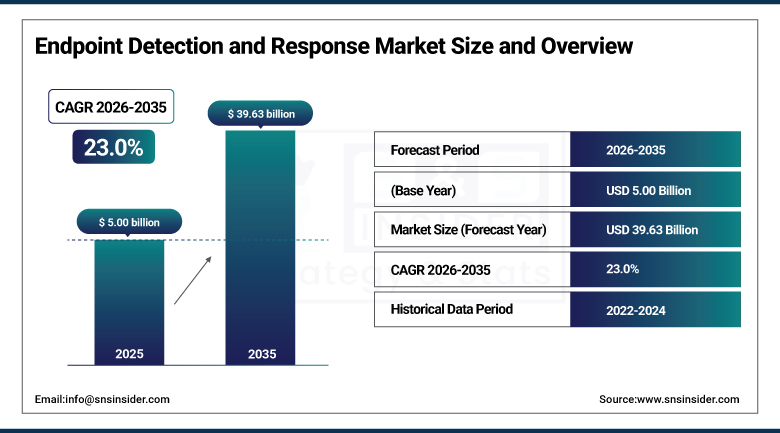
The Endpoint Detection and Response Market was valued at USD 5.00 Billion in 2025 and is projected to reach USD 39.63 Billion by 2035, registering a CAGR of 23.0% from 2026 to 2035.
The Endpoint Detection and Response (EDR) Market is witnessing exponential growth on account of the rising occurrence and complexity of cyber-attacks that occur through the enterprise's endpoints such as laptops, servers, mobile devices, and cloud workloads. With a rise in investments in next-generation EDR systems, organizations are able to achieve real-time monitoring, threat detection, incident response, and quick mitigation of any kind of security threats. The adoption of remote working and hybrid work practices has added to the attack surface area, thus increasing the demand for endpoint-focused security solutions. Increasing deployment of AI, machine learning and behavioral analysis for improving threat detection efficacy, faster response, and reduction of response time are contributing towards the growth of the market further. The increasing regulatory requirements, ransomware attacks, and cloud-based security platforms have further encouraged enterprises to implement EDR solutions in large numbers.
The decade ahead continues favoring vendors that can blend EDR for zero-day exploit prevention with container-level visibility across hybrid environments, as organizations increasingly seek unified security platforms capable of addressing multi-vector threats spanning traditional endpoints, cloud workloads, and identity-based attack surfaces simultaneously.
Market Size and Forecast
-
Market Size in 2026E: USD 6.15 Billion
-
Market Size by 2035: USD 39.63 Billion
-
CAGR: 23.0% from 2026 to 2035
-
Fastest Growing Region: Asia Pacific
-
Largest Region: North America
To Get more information Endpoint Detection and Response Market - Request Free Sample Report
Endpoint Detection and Response Market Trends
-
Efforts by cybersecurity companies to integrate artificial intelligence and machine learning continue improving anomaly detection and predictive insights, enhancing threat visibility and mitigation.
-
EDR solutions continue evolving beyond traditional endpoint security to address multi-vector threats, with companies adapting offerings to cover cloud environments.
-
Container-level visibility across hybrid environments continues becoming an increasingly important vendor differentiator amid enterprise cloud workload expansion.
-
Enterprise demand for comprehensive security combining endpoint monitoring, threat hunting, and automatic response capabilities continues propelling sustained market growth.
-
Password requirements and multi-factor authentication continue becoming essential features for securing endpoints, particularly across healthcare and other regulated sectors.
U.S. Endpoint Detection and Response Market Outlook
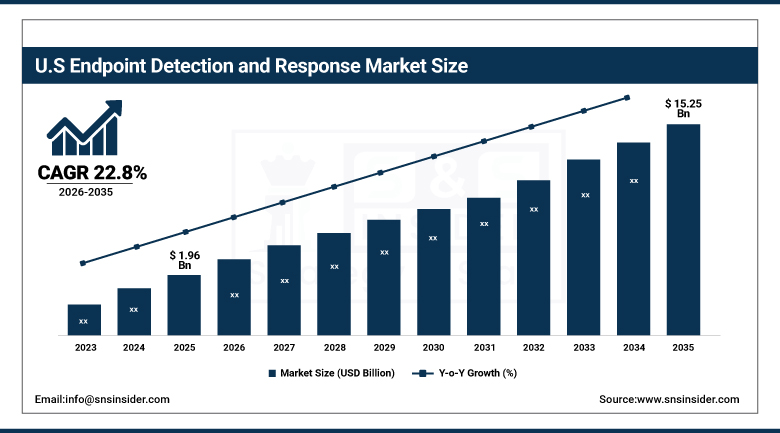
The U.S. Endpoint Detection and Response Market was valued at approximately USD 1.96 Billion in 2025 and is projected to reach approximately USD 15.25 Billion by 2035, registering a CAGR of approximately 22.8% from 2026 to 2035.
In the US, the growth of the market remained largely influenced by an increase in the number and complexity of cyberattacks, cloud computing adoption, and real-time threat detection and protection needs among businesses through the year. Increased efforts for endpoint security amid remote working, the application of artificial intelligence and machine learning for analyzing threats proactively, and regulatory compliance needs helped speed up market growth in the country. Strong government procurement policies for cybersecurity and the presence of a large number of managed security service providers in the country helped maintain its status as the largest national market for EDR systems.
CrowdStrike continued expanding its cloud-native endpoint protection and identity threat detection platform throughout 2025, targeting American enterprises seeking unified visibility across traditional endpoints, cloud workloads, and identity-based attack surfaces amid increasingly sophisticated, multi-vector cyber threats.
Endpoint Detection and Response Market Segment Analysis
-
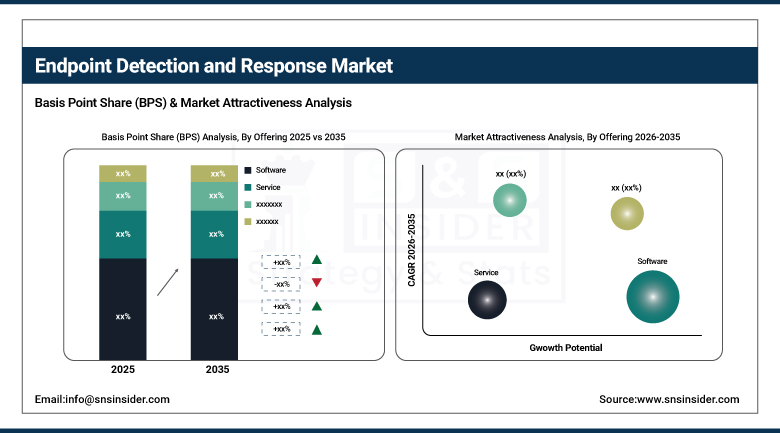
By Offering, Software segment dominated the Endpoint Detection and Response Market in 2025 with 72% share; Service segment is the fastest growing segment.
-
By Deployment, Cloud segment dominated the market in 2025 with 67% share; Cloud segment is the fastest growing segment.
-
By Endpoint Device, Network Devices & Servers segment dominated the market in 2025 with 48% share; Mobile Devices segment is the fastest growing segment.
-
By Organization Size, Large Enterprises segment dominated the market in 2025 with 69% share; Small & Medium-sized Enterprises segment is the fastest growing segment.
-
By End Use Industry, BFSI segment dominated the market in 2025 with 23% share; Healthcare & Life Sciences segment is the fastest growing segment.
By Offering, Software Segment Dominated the Endpoint Detection and Response Market, While Services Segment Is the Fastest Growing
The Software segment dominated the Endpoint Detection and Response Market owing to increasing implementation of advanced endpoint security solutions that offer continuous monitoring, real-time threat detection, automated response, and centralization of security management. The companies have started giving preference to software solutions for increasing their cyber resilience by protecting themselves from ransomware, phishing, and advanced persistent threats. Artificial intelligence, behavioral analysis, and security information and event management solutions have increased the utility of software solutions in increasing enterprise demand in varied industries.
The Service segment is the fastest growing in the Endpoint Detection and Response Market because of increasing need for managed detection and response, consulting, deployment, integration, and incident response services. Increasing complexity in cybersecurity and shortage of competent security professionals have encouraged the companies to outsource the management of endpoint security solutions to service providers. The services for continuous monitoring, quick threat investigation, compliance, and security optimization have helped in building effective protection for organizations.
By Deployment, Cloud Segment Dominated the Endpoint Detection and Response Market and Is Also the Fastest Growing
The Cloud Segment was the leading segment of the Endpoint Detection and Response Market, which was due to the increasing use of cloud-native security platforms by enterprises to provide scalability and visibility along with easier deployment. Cloud-based EDRs facilitate constant monitoring of dispersed endpoints in addition to working remotely and having hybrid IT environments. Reduced cost of infrastructure, automatic software updates, faster deployment, and integration with cloud applications have increased the demand for flexible and efficient cybersecurity solutions in organizations. The Cloud segment is the fastest growing one as a result of digital transformation, increasing hybrid work environment, and the migration of enterprise workloads into cloud infrastructure.
By Endpoint Device, Network Devices & Servers Segment Dominated the Endpoint Detection and Response Market, While Mobile Devices Segment Is the Fastest Growing
The Network Devices & Servers segment dominated the Endpoint Detection and Response Market since these endpoints house important business applications, sensitive enterprise data, and important IT infrastructure. The importance of ensuring that servers and network devices are protected against ransomware attacks, insider threats, and cyber-attacks is a priority in organizations. This is why the use of centralized monitoring, threat detection, automation of responses, and continuous security assessment has boosted the growth of endpoint detection and response solutions in enterprises' network infrastructures.
The Mobile Devices segment is the fastest growing owing to the growing mobility in enterprises, BYOD policies, and remote workforce operations. Mobile devices such as smartphones and tablets have become essential access points to enterprise applications and data. The need to protect enterprise assets using mobile endpoint detection solutions capable of providing threat monitoring, malware detection, device visibility, and enforcement of policies has increased among enterprises.
By Organization Size, Large Enterprises Segment Dominated the Endpoint Detection and Response Market, While Small and Medium-sized Enterprises (SMEs) Segment Is the Fastest Growing
The Large Enterprises segment dominated the Endpoint Detection and Response Market owing to their digital infrastructure, endpoint ecosystem, and exposure to advanced attacks on their systems. Such organizations use advanced technology for cybersecurity because they need to ensure protection of important business operations and customer data. Financial strength, dedicated security teams, and increased use of artificial intelligence-based endpoint detection platforms would drive adoption within large enterprises.
The Small and Medium-sized Enterprises segment is the fastest growing because of rising numbers of cyber threats against small enterprises with low technical skills in handling such cyber security. Due to affordability, the cloud-based endpoint detections have become more accessible for SMEs. Increased consciousness regarding cyber security issues, compliance and securing of the remote work environment is increasing the adoption of endpoint detections in this business category.
By End Use Industry, BFSI Segment Dominated the Endpoint Detection and Response Market, While Healthcare & Life Sciences Segment Is the Fastest Growing
The BFSI segment dominated the Endpoint Detection and Response Market owing to its highly vulnerable nature from cyber threats, ransomware attacks, phishing attacks, and data breaches of critical financial information. The sector needs continuous endpoint detection and fast responses to any incidents. Continuous increase in digitized banking and investments made by the companies in cyber security infrastructure further drives the growth of endpoint detections in the BFSI segment.
The Healthcare & Life Sciences segment is the fastest growing because of the digitalization of healthcare systems, connected devices, and eHealth records, which increases cyber threats. Advanced endpoint protection solutions are needed for the protection of sensitive information and compliance with cybersecurity requirements. The growing number of ransomware attacks, expanding telemedicine, and increased spending on healthcare IT infrastructure further promote the use of EDR solutions.
Regional Insights
|
Region |
Major Country |
Share within Region, 2025 (%) |
|---|---|---|
|
North America |
United States |
85.10% |
|
Europe |
United Kingdom |
24.05% |
|
Asia Pacific |
China |
30.65% |
|
Middle East and Africa |
UAE |
27.20% |
|
Latin America |
Brazil |
34.05% |
North America Endpoint Detection and Response Market Insights
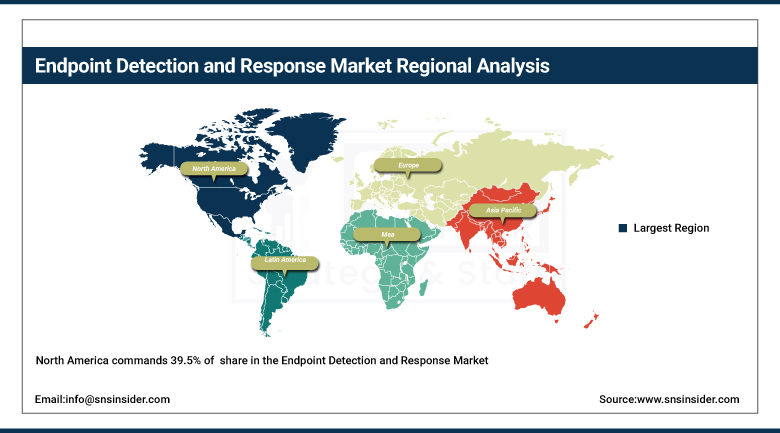
North America commands 39.5% of share in the Endpoint Detection and Response Market, anchored by heightened federal cybersecurity spending and a dense concentration of managed security service providers headquartered across the continent. That combination of substantial government and enterprise cybersecurity budgets kept the continent firmly positioned as the market's clear leader by a considerable margin over every other region tracked in this report.
The United States accounted for roughly 85.10% of regional revenue, anchored by heightened federal procurement rules and a dense concentration of leading cybersecurity technology developers. Canada added further regional demand through its own growing enterprise cybersecurity investment, and that combined strength kept North America the largest addressable market for endpoint detection and response vendors through the forecast period.
Get Customized Report as per Your Business Requirement - Enquiry Now
Europe Endpoint Detection and Response Market Insights
The European EDR market is growing steadily, driven by stringent data protection regulations, rising cyberattacks, and increasing adoption of AI-powered threat detection. Enterprises across finance, healthcare, and government sectors are investing in proactive endpoint security solutions to safeguard sensitive data, ensure compliance, and mitigate advanced persistent threats effectively.
The United Kingdom led demand at roughly 24.05% of European revenue, supported by its substantial financial services and technology sector cybersecurity investment. Germany and France contributed substantial additional demand, and continued European regulatory emphasis on operational resilience should keep regional demand climbing through the forecast period.
Asia Pacific Endpoint Detection and Response Market Insights
Asia-Pacific region is expected to emerge as the fastest-growing segment in the endpoint detection and response market from 2026-2033. The rapid digital transformation in countries like India, China, and Japan, along with rising cyber threats in these economies, drives demand for endpoint detection and response solutions. Investments in cybersecurity infrastructure by both government and private sectors further fuel growth. For instance, Japan’s commitment to cybersecurity ahead of the 2023 events, and China’s focus on data protection laws, are encouraging enterprises to adopt advanced endpoint detection and response technologies to safeguard their digital assets.
China led the pack, supported by its massive enterprise technology sector and rapidly growing domestic cybersecurity investment. India and Japan contributed meaningful additional demand, with expanding digital transformation and regulatory compliance timelines continuing to reinforce Asia Pacific's position as a genuinely important growth market tracked in this report.
Middle East and Africa and Latin America Endpoint Detection and Response Market Insights
The LATAM and MEA EDR markets are expanding due to rising digitalization, growing cybercrime, and increasing awareness of cybersecurity best practices. Organizations in banking, telecommunications, and government sectors are adopting advanced EDR solutions to protect endpoints, enhance threat visibility, and maintain business continuity across complex network environments.
The UAE led Middle East and Africa demand, supported by substantial sovereign digital transformation investment and national cybersecurity strategy implementation. Saudi Arabia contributed further demand through its own infrastructure modernization programs. In Latin America, Brazil accounted for the largest share of regional revenue, with growing enterprise cybersecurity investment continuing to anchor regional demand for endpoint detection and response solutions.
Growth Drivers: Cyber Threat Sophistication and Regulatory Compliance Requirements
The Endpoint Detection and Response market is evolving rapidly, driven by the increasing complexity of cyber threats and the need for advanced, real-time detection solutions. The market's growth continues being propelled by enterprise demand for comprehensive security that combines endpoint monitoring, threat hunting, and automatic response capabilities across increasingly diverse, distributed endpoint fleets.
Heightened federal procurement rules, the commercialization of ransomware toolkits, and a steady pivot to cloud-delivered security have all accelerated refresh cycles, turning EDR from an optional upgrade into a genuine line-item requirement. That combination of genuine threat escalation and expanding regulatory mandate is exactly what keeps demand climbing at such a rapid, sustained pace across virtually every major enterprise category this market serves.
Restraints: Integration Complexity and Cybersecurity Talent Shortage
Integration complexity continues posing a genuine restraint on faster market-wide deployment, as organizations increasingly report challenges integrating endpoint detection and response platforms with existing, often heterogeneous security infrastructure. That integration burden keeps full-scale EDR deployment a genuinely multi-year undertaking for many larger, more complex enterprise environments.
Talent shortage continues posing a further restraint, as the specialized cybersecurity expertise required to properly configure, monitor, and respond to EDR platform alerts remains in genuinely short supply relative to demand across the industry. That talent scarcity keeps managed detection and response services genuinely important alongside core platform licensing for organizations lacking dedicated in-house security operations capability.
Opportunities: Identity-Threat Detection Expansion and SME Market Democratization
Identity-threat detection and response represents a genuinely significant opportunity, as this solution category's fastest-growing status among all segments tracked in this market reflects genuine enterprise demand for managed EDR services capable of addressing increasingly sophisticated, identity-based attack vectors. Vendors offering genuinely proven, identity-integrated threat detection technology stand to capture meaningful share as attackers increasingly target identity infrastructure rather than traditional endpoint vulnerabilities alone.
Rising small and medium enterprise adoption offers a second substantial opportunity, as this enterprise-size category's fastest-growing status reflects genuine demand democratization beyond the market's traditional large-enterprise stronghold. Vendors positioned to serve this expanding SME customer base with genuinely affordable, easy-to-deploy cloud-delivered EDR platforms stand to capture meaningful share as smaller organizations increasingly recognize their own cyber risk exposure.
Recent Developments:
-
2025: Palo Alto Networks continued expanding its cloud-native endpoint and identity threat detection platform, targeting enterprise customers seeking unified visibility across hybrid, multi-cloud environments.
-
2025: SentinelOne continued advancing its AI-driven autonomous threat response technology, targeting healthcare and financial services customers seeking automated, real-time endpoint remediation capability.
-
2024: Trend Micro continued expanding its extended detection and response platform, integrating endpoint, cloud, and network telemetry to provide genuinely comprehensive multi-vector threat visibility for enterprise customers.
Endpoint Detection and Response Market Key Players:
-
Bitdefender
-
Broadcom, Inc.
-
Carbon Black Inc.
-
Check Point Software Technologies Ltd.
-
Cisco Systems, Inc.
-
Cybereason Inc.
-
Elastic N.V.
-
FireEye
-
Fortinet, Inc.
-
Intel Corporation
-
Kaspersky Lab
-
Microsoft Corporation
-
Palo Alto Networks
-
RSA Security LLC
-
SentinelOne
-
Sophos Ltd.
-
Symantec Corporation
-
VMware Carbon Black
Endpoint Detection and Response Market Report Scope:
| Report Attributes | Details |
|---|---|
| Market Size in 2025 | USD 5.00 Billion |
| Market Size by 2035 | USD 39.63 Billion |
| CAGR | CAGR of 23.0% From 2026 to 2035 |
| Base Year | 2025 |
| Forecast Period | 2026-2035 |
| Historical Data | 2022-2024 |
| Report Scope & Coverage | Market Size, Segments Analysis, Competitive Landscape, Regional Analysis, DROC & SWOT Analysis, Forecast Outlook |
| Key Segments | By Offering (Software, Service) By Deployment (Cloud, On-premise) By Endpoint Device (Network Devices & Servers, Mobile Devices, Point Of Sale (POS) Devices, Others) By Organization Size (Small & Medium-sized Enterprises, Large Enterprises) By End Use Industry (BFSI, Healthcare & Life Sciences, Government & Defense, Retail & E-commerce, IT & Telecom, Energy & Utilities, Manufacturing, Others) |
| Regional Analysis/Coverage | North America (US, Canada), Europe (Germany, UK, France, Italy, Spain, Russia, Poland, Rest of Europe), Asia Pacific (China, India, Japan, South Korea, Australia, ASEAN Countries, Rest of Asia Pacific), Middle East & Africa (UAE, Saudi Arabia, Qatar, South Africa, Rest of Middle East & Africa), Latin America (Brazil, Argentina, Mexico, Colombia, Rest of Latin America). |
| Company Profiles | Bitdefender, Broadcom, Inc., Carbon Black Inc., Check Point Software Technologies Ltd., Cisco Systems, Inc., Crowdstrike Inc., Cybereason Inc., Elastic N.V., FireEye, Fortinet, Inc., Intel Corporation, Kaspersky Lab, McAfee, LLC, Microsoft Corporation, Palo Alto Networks, RSA Security LLC, SentinelOne, Sophos Ltd., Symantec Corporation, VMware Carbon Black |

Frequently Asked Questions
The Endpoint Detection and Response Market is expected to grow at a CAGR of approximately 23.0% from 2026 to 2035.
The Endpoint Detection and Response Market was valued at approximately USD 5.00 Billion in 2025.
The major growth factor is the increasing complexity of cyber threats combined with the need for advanced, real-time detection solutions and stringent data security laws.
The Software segment dominated the Endpoint Detection and Response in 2025.
North America dominated the Endpoint Detection and Response Market in 2025.
