
Nucleic Acid-based Therapeutics Market Report Scope & Overview:
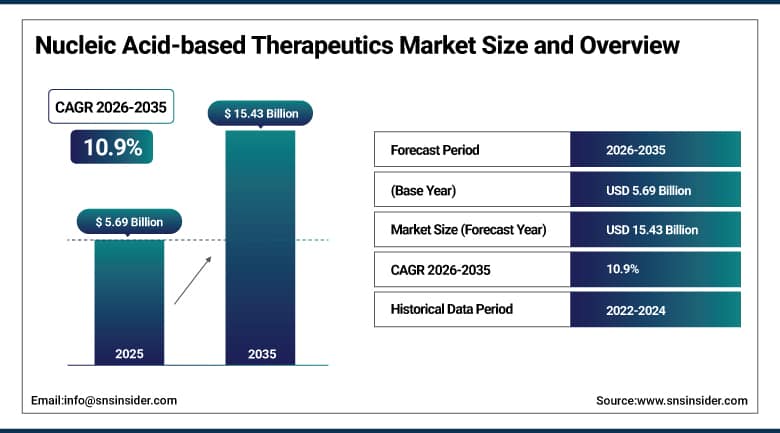
The Nucleic Acid-based Therapeutics Market was valued at USD 5.69 Billion in 2025 and is expected to reach USD 15.43 Billion by 2035, growing at a CAGR of 10.9% from 2026–2035.
Nucleic acid-based therapeutics use synthetic or natural nucleic acids, including antisense oligonucleotides, siRNA, mRNA, aptamers, and CRISPR/Cas9-based genome editing tools, to control gene expression and directly address the underlying genetic causes of disease rather than treating symptoms alone. This class of therapeutics offers a precise, targeted approach to managing rare genetic disorders, cancers, and viral infections with identifiable genetic drivers, and continues to benefit from rapid advancement in genomic technologies and delivery platform sophistication. RNA interference and mRNA-based approaches collectively account for the majority of current market activity, reflecting both their therapeutic versatility and the relative maturity of their clinical development pipelines following the mRNA vaccine platform's rapid validation during the recent global pandemic.
In May 2025, Biogen and City Therapeutics entered a strategic research collaboration to develop novel RNA interference-based therapies targeting central nervous system diseases, combining City Therapeutics' RNAi engineering technologies with Biogen's established drug development expertise in neurological disorders.
To Get More Information On Nucleic Acid-based Therapeutics Market - Request Free Sample Report
Nucleic Acid-based Therapeutics Market Trends
-
Rising adoption of lipid nanoparticle delivery systems expanding tissue targeting beyond liver-focused applications
-
Growing CRISPR/Cas9 and base-editing therapeutic pipeline development for genetic and blood disorders
-
Increasing biotech-pharma collaboration combining platform technology with established drug development expertise
-
Rising demand for chemically modified guide RNAs and donor templates supporting precision gene editing therapies
-
Growing investment in mRNA-based cancer immunotherapy pipelines beyond infectious disease vaccine applications
-
Expanding vertical integration of lipid nanoparticle manufacturing capability within contract development organizations
U.S. Nucleic Acid-based Therapeutics Market Outlook
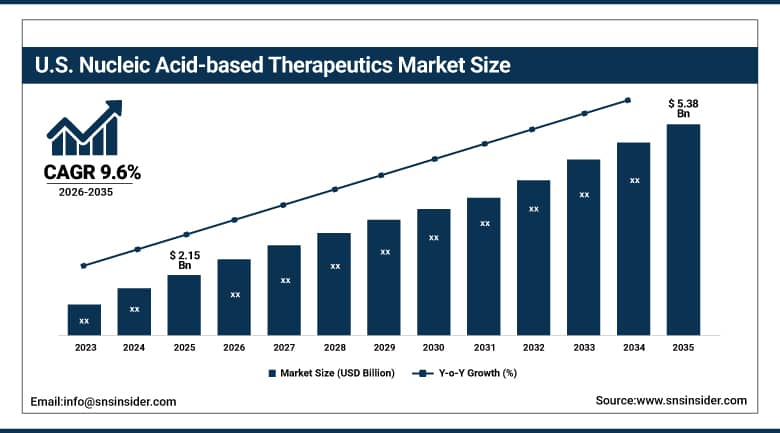
The U.S. Nucleic Acid-based Therapeutics Market was valued at approximately USD 2.15 Billion in 2025 and is expected to reach approximately USD 5.38 Billion by 2035, growing at a CAGR of approximately 9.6%.
U.S. market gains due to high incidence of chronic and hereditary conditions, high degree of specialization of biotech companies developing RNA and gene-editing technologies, and solid investment in research and development from both the government and private sources. The regulatory environment in the U.S., although very strict, has shown an ability for a fast development of pathways for novel therapeutics as proven by accelerated approval pathways adopted in the case of mRNA vaccines. U.S.-based contract research organizations will increasingly develop vertical integration of their capabilities to formulate lipid nanoparticles, which is aimed at simplification of RNA drug delivery and minimizing dependency on third-party manufacturers with specialty capabilities for this stage of the process. Mandates for newborn genetic screening programs on state and employer levels will increase the number of potential patients eligible for nucleic acid-based rare disease treatments.
According to CDC National Diabetes Statistics, more than 130 million people in the United States currently live with diabetes or prediabetes, underscoring the scale of the chronic disease population that continues to drive sustained U.S. investment in nucleic acid-based therapeutic research and development across multiple disease categories.
Nucleic Acid-based Therapeutics Market Segment Analysis
-
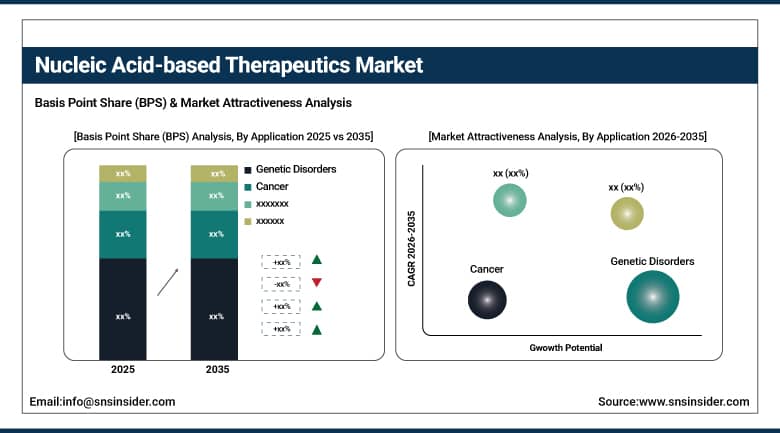
By Application, the Genetic Disorders segment dominated the Nucleic Acid-based Therapeutics Market with approximately 34.8% share in 2025, while the Cancer segment is the fastest growing with a CAGR of approximately 15.2%.
-
By Technology, the RNA-Targeted Therapeutics segment dominated the Nucleic Acid-based Therapeutics Market with approximately 54.6% share in 2025, while the Genome Editing Therapies segment is the fastest growing with a CAGR of approximately 18.4%.
-
By End User, the Hospitals & Clinics segment dominated the Nucleic Acid-based Therapeutics Market with approximately 48.3% share in 2025, while the Academic & Research Institutes segment is the fastest growing with a CAGR of approximately 15.7%.
By Application, Genetic Disorders dominates, Cancer grows fastest
Genetic Disorders dominated the Nucleic Acid-based Therapeutics Market in 2025 due to the fact that rare genetic diseases with clearly identifiable single-gene causes represent the most directly addressable application for nucleic acid-based intervention, offering a precise mechanistic fit between the underlying disease driver and the therapeutic modality's targeted mode of action.
Cancer is the fastest-growing segment in the Nucleic Acid-based Therapeutics Market due to the fact that mRNA-based cancer immunotherapy and RNA interference approaches targeting oncogenic pathways continue to advance rapidly through clinical development, offering the potential for highly personalized cancer treatment approaches that traditional small-molecule and biologic therapies cannot replicate.
By Technology, RNA-Targeted Therapeutics dominates, Genome Editing Therapies grows fastest
RNA-Targeted Therapeutics dominated the Nucleic Acid-based Therapeutics Market in 2025 due to the fact that antisense oligonucleotide, siRNA, and mRNA platforms collectively benefit from the most mature clinical development pipelines and regulatory track record of any nucleic acid therapeutic modality, reinforced by the rapid validation of mRNA technology during recent global vaccine deployment at unprecedented scale.
Genome Editing Therapies is the fastest-growing segment in the Nucleic Acid-based Therapeutics Market due to the fact that CRISPR/Cas9 and next-generation base-editing platforms are advancing rapidly through clinical trials for genetic liver and blood disorders, offering the potential for durable, one-time genetic correction rather than the repeated dosing typically required by RNA-targeted approaches. There is increasing demand for ultra-precise, chemically modified guide RNAs and donor templates as base editing avoids double-strand DNA breaks, requiring highly accurate oligonucleotide synthesis and advanced validation processes.
By End User, Hospitals & Clinics dominates, Academic & Research Institutes grows fastest
Hospitals & Clinics dominated the Nucleic Acid-based Therapeutics Market in 2025 due to the fact that approved nucleic acid therapeutic products are predominantly administered in clinical settings requiring specialized handling, infusion, and patient monitoring capability, making hospitals and specialty clinics the primary point of care for this therapeutic class.
Academic & Research Institutes is the fastest-growing segment in the Nucleic Acid-based Therapeutics Market due to the fact that growing government and private research funding continues to expand early-stage discovery and preclinical development activity at universities and research institutions, which increasingly serve as the origination point for novel nucleic acid platform technologies subsequently licensed to biotech and pharmaceutical partners.
Regional Analysis
|
Region |
Major Country |
Share within Region, 2025 (%) |
|---|---|---|
|
North America |
United States |
83.0% |
|
Europe |
Germany |
30.0% |
|
Asia Pacific |
China |
36.0% |
|
Middle East & Africa |
Saudi Arabia |
21.0% |
|
Latin America |
Brazil |
27.0% |
North America Nucleic Acid-based Therapeutics Market Insights
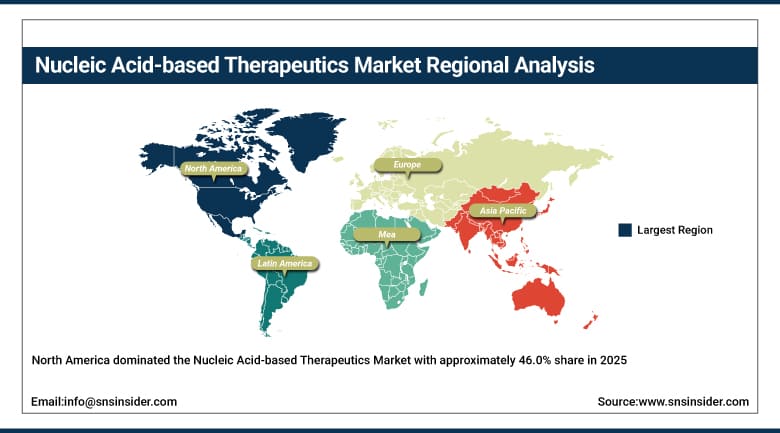
North America dominated the Nucleic Acid-based Therapeutics Market with approximately 46.0% share in 2025, supported by the high prevalence of chronic and genetic diseases, growing need for targeted and personalized therapy, and strong supportive government research funding activity across the region.
Canadian biotech research institutions continue to expand nucleic acid therapeutics discovery activity, often in close collaboration with U.S. pharmaceutical partners, while Mexican clinical trial infrastructure is gradually expanding to support regional access to approved nucleic acid therapeutic products. U.S. academic medical centers continue to serve as key clinical trial sites for novel nucleic acid therapeutic candidates, leveraging deep genetic disease patient registries and specialized clinical trial infrastructure built over multiple decades of rare disease research investment.
Get Customized Report as Per Your Business Requirement - Enquiry Now
Europe Nucleic Acid-based Therapeutics Market Insights
Europe's market, representing approximately 28% of global share, is supported by strong biotech research clusters in Germany, the UK, and Switzerland, alongside a regulatory environment increasingly aligned with accelerated approval pathways for novel genetic and rare disease therapeutics.
Swiss biotech clusters, anchored by major pharmaceutical company research operations, continue to drive substantial nucleic acid therapeutics discovery and early clinical development activity within the broader European market.
Asia Pacific Nucleic Acid-based Therapeutics Market Insights
Asia Pacific is the fastest-growing region in the Nucleic Acid-based Therapeutics Market, led by China and Japan, where expanding domestic biotech investment and growing government support for genomic medicine research continue to accelerate regional pipeline development at a pace outstripping more mature Western markets.
China’s biotech firms have continued to increase their capacity-building efforts regarding platform development for nucleic acid-based therapies, driven by significant venture capital investments domestically and the increased government focus on genomics medicine as an important national industry, while Japan maintains its regional leadership position in innovation through regulatory approval pathways for novel gene and cell therapies. Biotech firms from South Korea have continued to make increased investments in the research of nucleic acid therapeutics, driven by increased government investments in genomics medicine research.
MEA & Latin America Nucleic Acid-based Therapeutics Market Insights
The Middle East & Africa region is growing steadily as Gulf state healthcare investment increasingly prioritizes advanced genomic medicine capability, with Saudi Arabia and the UAE expanding specialized treatment center infrastructure to support access to novel nucleic acid therapeutic products. Saudi Arabia's Vision 2030 healthcare modernization initiatives continue to fund specialized genomic medicine treatment centers, positioning the kingdom as an early regional adopter of advanced nucleic acid therapeutic access programs.
Latin America is growing steadily as Brazilian and Mexican healthcare systems gradually expand access to novel nucleic acid therapeutics, supported by growing regional clinical trial participation and expanding specialty pharmacy distribution infrastructure. Brazilian and Argentine clinical research infrastructure continues to expand, supported by growing multinational pharmaceutical company interest in conducting regional clinical trials that both accelerate local regulatory pathways and reduce overall global development timelines.
Market Dynamics
Growth Drivers: Rising genetic disease prevalence and genomic technology advancement fueling adoption
Increasing prevalence of genetic and chronic diseases worldwide continues to expand the addressable patient population for nucleic acid-based therapeutics, particularly as improved genetic testing and diagnostic capability identify more patients with clearly targetable genetic disease drivers. Continued advances in genomics and molecular biology are steadily expanding the range of diseases addressable by nucleic acid-based approaches, moving beyond early rare-disease applications into more common chronic conditions with more complex, multi-gene disease architectures.
Growing investment in research and development, reinforced by the mRNA vaccine platform's rapid clinical and commercial validation, continues to attract substantial venture capital and pharmaceutical partner funding toward nucleic acid therapeutic platform development across multiple technology categories. Rising demand for personalized and precision medicine approaches continues to favor nucleic acid-based therapeutics, given the technology's inherent capacity for highly targeted, patient-specific therapeutic design relative to conventional small-molecule drug development approaches. Growing newborn genetic screening program adoption across multiple countries continues to identify a larger population of patients eligible for early-intervention nucleic acid therapeutics, expanding the addressable patient pool for rare genetic disease treatments before irreversible disease progression occurs.
Restraints: Manufacturing complexity and high treatment costs limiting broader access
Manufacture of nucleic acid therapies, especially genome-editing medicines that require high chemical modification precision in guide RNAs and donor templates, is far more complex than small molecule pharmaceutical production, and hence is an additional barrier to scale-up and increase cost per unit. The cost of therapy with many approved nucleic acid therapies, especially those treating rare diseases, remains high and creates issues regarding insurance and reimbursement that hinder their wide utilization by patients despite clear evidence of effectiveness in trials.
Limited development of delivery technology is a major issue in nucleic acid therapies, since it limits the number of tissues and organs amenable to treatment with such drugs. There are more clinically validated nucleic acid therapies that target the liver compared to the brain and muscle, among others. There is limited safety and longevity data with new genome editing therapies, hence some hesitation from a clinical and regulatory point of view for one-off treatments.
Opportunities: Extrahepatic delivery innovation and oncology pipeline expansion widening addressable demand
Continued development of novel delivery systems capable of reaching extrahepatic tissues, including the central nervous system and muscle, presents a significant opportunity to expand nucleic acid therapeutics beyond current liver-focused applications into a substantially broader range of disease targets. Rapid expansion of mRNA-based and RNA interference cancer immunotherapy pipelines presents a substantial growth opportunity, as oncology represents a far larger addressable patient population than the rare genetic disorders that have historically anchored nucleic acid therapeutic development.
Growing contract development and manufacturing organization investment in vertically integrated lipid nanoparticle and oligonucleotide synthesis capability presents an opportunity for specialized manufacturers to capture a larger share of the expanding nucleic acid therapeutics supply chain as biotech customers increasingly outsource complex manufacturing steps. Growing payer and health system interest in outcomes-based and value-based payment models for high-cost, potentially curative nucleic acid therapeutics presents an opportunity to improve patient access while providing manufacturers a pathway to demonstrate long-term value beyond traditional upfront pricing models.
Recent Developments:
-
In May 2025, Biogen and City Therapeutics entered a strategic research collaboration to develop RNA interference-based therapies targeting central nervous system diseases.
-
In September 2024, ME Therapeutics commenced efficacy testing of mRNA formulations developed through its collaboration with NanoVation Therapeutics, focused on advancing RNA-based cancer immunotherapies.
-
In January 2024, TransCode Therapeutics and Debiopharm announced a co-research agreement to develop targeted nucleic acid therapeutics for cancer, combining TransCode's TTX delivery platform with Debiopharm's targeted drug delivery expertise.
-
In 2025, Imugene launched a novel plasmid-based DNA vaccine designed to stimulate immune responses in breast cancer, demonstrating increased T-cell infiltration into tumor sites in Phase I clinical trials.
-
In 2024, Alnylam Pharmaceuticals expanded its RNAi therapeutic pipeline with new clinical trial initiations targeting additional genetic and cardiometabolic disease indications.
-
In 2025, Beam Therapeutics continued advancing base-editing programs for genetic liver and blood disorders, relying on specialized GMP oligonucleotide supply chains for precision guide RNA manufacturing.
Nucleic Acid-based Therapeutics Market Key Players
-
Alnylam Pharmaceuticals Inc.
-
Ionis Pharmaceuticals Inc.
-
Moderna Inc.
-
BioNTech SE
-
Novartis Pharma AG
-
Sarepta Therapeutics Inc.
-
Silence Therapeutics plc
-
Wave Life Sciences Ltd.
-
Beam Therapeutics Inc.
-
Intellia Therapeutics Inc.
-
CRISPR Therapeutics AG
-
Arrowhead Pharmaceuticals Inc.
-
Protagonist Therapeutics Inc.
-
Biogen Inc.
-
Amgen Inc.
-
Pfizer Inc.
-
Regeneron Pharmaceuticals
-
Vertex Pharmaceuticals
-
Editas Medicine Inc.
-
Genevant Sciences
Nucleic Acid-based Therapeutics Market Report Scope:
| Report Attributes | Details |
|---|---|
| Market Size in 2025 | USD 5.69 Billion |
| Market Size by 2035 | USD 15.43 Billion |
| CAGR | CAGR of 10.9% From 2026 to 2035 |
| Base Year | 2025 |
| Forecast Period | 2026-2035 |
| Historical Data | 2022-2024 |
| Report Scope & Coverage | Market Size, Segments Analysis, Competitive Landscape, Regional Analysis, DROC & SWOT Analysis, Forecast Outlook |
| Key Segments | • by Technology (RNA-Targeted Therapeutics, Gene Therapies, Genome Editing Therapies, Epigenetic & microRNA Modulating Therapies) • by Application (Genetic Disorders, Cancer, Infectious Diseases, Autoimmune Disorders) • by End User (Hospitals & Clinics, Academic & Research Institutes, Others) |
| Regional Analysis/Coverage | North America (US, Canada), Europe (Germany, UK, France, Italy, Spain, Russia, Poland, Rest of Europe), Asia Pacific (China, India, Japan, South Korea, Australia, ASEAN Countries, Rest of Asia Pacific), Middle East & Africa (UAE, Saudi Arabia, Qatar, South Africa, Rest of Middle East & Africa), Latin America (Brazil, Argentina, Mexico, Colombia, Rest of Latin America). |
| Company Profiles | Alnylam Pharmaceuticals Inc., Ionis Pharmaceuticals Inc., Moderna Inc., BioNTech SE, Novartis Pharma AG, Sarepta Therapeutics Inc., Silence Therapeutics plc, Wave Life Sciences Ltd., Beam Therapeutics Inc., Intellia Therapeutics Inc., CRISPR Therapeutics AG, Arrowhead Pharmaceuticals Inc., Protagonist Therapeutics Inc., Biogen Inc., Amgen Inc., Pfizer Inc., Regeneron Pharmaceuticals, Vertex Pharmaceuticals, Editas Medicine Inc., Genevant Sciences |

Frequently Asked Questions
Leading companies include Alnylam Pharmaceuticals Inc., Ionis Pharmaceuticals Inc., Moderna Inc., BioNTech SE, and Novartis Pharma AG, among other major RNA therapeutics and genome editing biotechnology companies.
Opportunities include continued development of extrahepatic delivery systems reaching the central nervous system and muscle, rapid expansion of mRNA and RNA interference cancer immunotherapy pipelines, and growing CDMO investment in vertically integrated manufacturing capability
Growth is driven by increasing prevalence of genetic and chronic diseases, continued advances in genomics and molecular biology, growing R&D investment following mRNA platform validation, and rising demand for personalized precision medicine approaches.
RNA-Targeted Therapeutics dominates by technology with approximately 54.6% share, Genetic Disorders dominates by application with roughly 34.8% share, and Hospitals & Clinics dominates by end user with about 48.3% share; Genome Editing Therapies, Cancer, and Academic & Research Institutes are the fastest-growing segments within their respective categories.
North America is the largest regional market with approximately 46.0% share, led by the United States, while Asia Pacific, led by China, is the fastest-growing region through 2035.
