
5G IoT Market Report Scope and Overview:
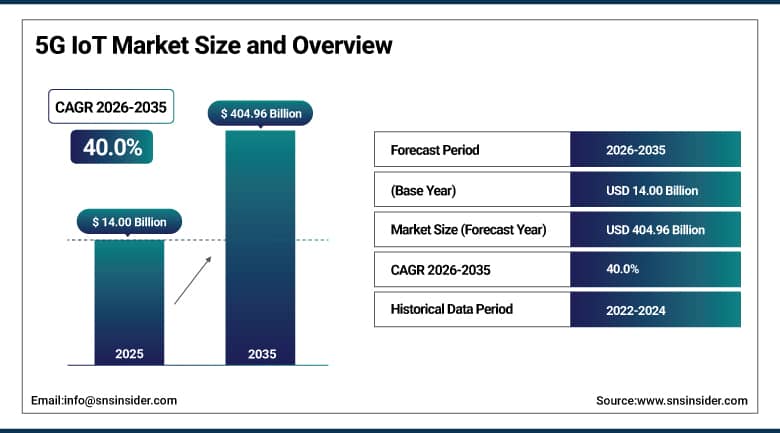
The 5G IoT Market was valued at USD 14.00 Billion in 2025 and is projected to reach USD 404.96 Billion by 2035, registering a CAGR of 40.0% from 2026 to 2035.
The 5G IoT Market is witnessing tremendous growth due to the expanding application of 5G technology and the increasing requirement for fast and reliable connectivity. Businesses are implementing 5G-powered IoT solutions to enable real-time data processing and automation, as well as for applications like smart manufacturing, connected cars, and smart cities. The increasing use of industrial IoT, edge computing, and autonomy solutions is playing a key role in driving the adoption of these solutions in the market. Increased investments in digitalization, smart infrastructure, and new generation communication networks are further contributing to driving demand. Moreover, increased adoption of connected devices in healthcare, agriculture, logistics, and energy industry, as well as enhanced network scalability and reliability, are promoting enterprises to implement 5G IoT solutions in the market.
Rising tariffs on 5G IoT components and semiconductors in 2025 have increased costs for firms relying on global supply chains, with enterprises reacting by reassessing procurement strategies, exploring regional manufacturing hubs, and deploying dual sourcing to contain expenses amid an increasingly complex global trade environment affecting the broader 5G IoT hardware supply chain.
To Get More Information On 5G IoT Market - Request Free Sample Report
5G IoT Market Trends
-
The trend of integrating two advanced technologies continues gaining traction worldwide, benefiting overall demand for 5G IoT solutions.
-
Growing adoption of automation and rising popularity of connected devices continue helping the 5G IoT demand outlook.
-
Advancements in artificial intelligence technologies continue promoting demand for edge and cloud computing, expanding the addressable 5G IoT market.
-
Surge in connected devices and ultra-low latency applications continues advancing across healthcare, automotive, and industrial sectors.
-
Rising demand for private 5G networks in manufacturing and enterprise environments continues representing a genuinely significant emerging opportunity.
U.S. 5G IoT Market Outlook
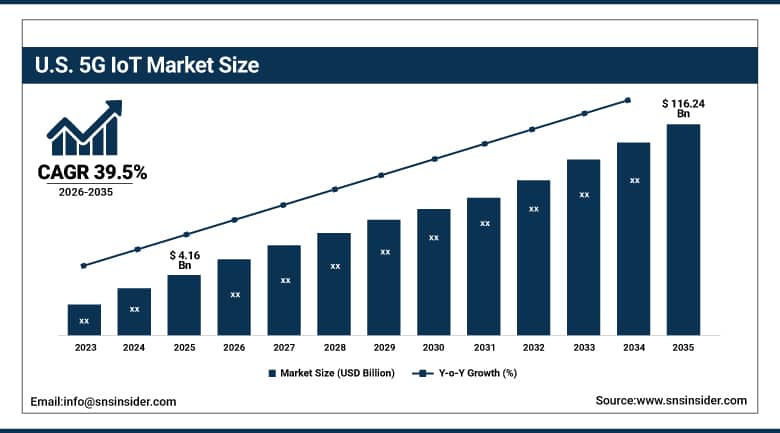
The U.S. 5G IoT Market was valued at approximately USD 4.16 Billion in 2025 and is projected to reach approximately USD 116.24 Billion by 2035, registering a CAGR of approximately 39.5% from 2026 to 2035.
U.S. 5G IoT Market Growth will continue at an impressive pace owing to the high adoption of advanced connectivity technology in different verticals including manufacturing, healthcare, automotive and logistics. Rising investments in 5G networking, smart cities projects, and industrial automation are propelling the need for high-speed and low latency IoT connectivity solutions. Moreover, increasing deployment of connected devices, edge computing, and real-time analytics solutions are fueling the growth of the market. In addition, rising demand for autonomous cars, remote health care solutions, and smart manufacturing solutions is boosting the adoption of IoT technologies. Moreover, government policies and developments by telecom operators in favor of next generation communication technology are also aiding the market growth.
Qualcomm continued expanding its 5G IoT chipset and modem technology portfolio throughout 2025, targeting American manufacturers and telecommunications customers seeking increasingly efficient, cost-competitive 5G connectivity solutions capable of supporting rapidly expanding connected device deployment across industrial and consumer applications.
5G IoT Market Segment Analysis
-
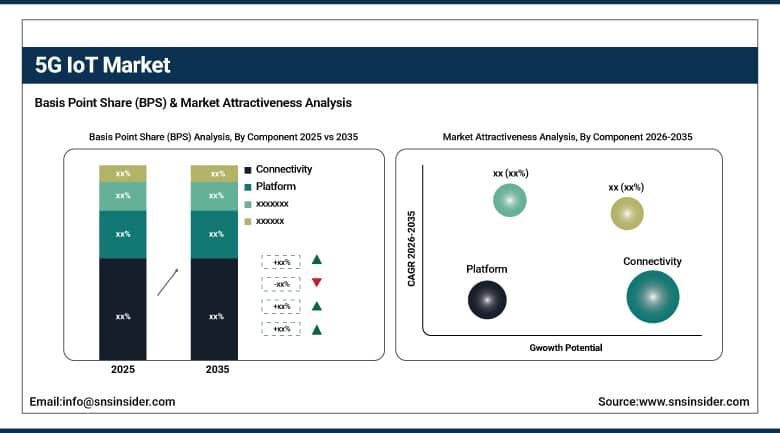
By Component, Connectivity segment dominated the 5G IoT Market in 2025 with 38% share; Platform segment is the fastest growing segment.
-
By Organization Size, Large Enterprises segment dominated the market in 2025 with 68% share; SMEs segment is the fastest growing segment.
-
By Network Type, 5G Standalone segment dominated the market in 2025 with 57% share; 5G Standalone segment is the fastest growing segment.
-
By Type, Wide-range IoT Devices segment dominated the market in 2025 with 62% share; Short-range IoT Devices segment is the fastest growing segment.
-
By End-User, Manufacturing segment dominated the market in 2025 with 24% share; Healthcare segment is the fastest growing segment.
By Component, Connectivity Segment Dominated the 5G IoT Market, While Platform Segment Is the Fastest Growing
The Connectivity segment dominated the 5G IoT Market owing to the rising demand for reliable, high-speed, and low-latency communication systems that facilitate the interconnectivity of connected devices. There is rising deployment of advanced connectivity technologies in organizations to facilitate seamless and efficient functioning through connected devices and IoT. Increasing implementation of smart infrastructure and industrial automation is driving the demand for 5G connectivity technology solutions.
The Platform segment is the fastest growing due to increasing demand for IoT management platforms for monitoring connected devices, managing and analyzing the generated data, and developing applications. Companies are opting for 5G IoT platforms for facilitating the management of their connected devices along with gaining meaningful insights into the vast amount of data being generated. Increasing adoption of AI, edge computing, and cloud-based IoT platforms is driving the demand for the same.
By Organization Size, Large Enterprises Segment Dominated the 5G IoT Market, While SMEs Segment Is the Fastest Growing
The Large Enterprises segment dominated the 5G IoT Market owing to greater spending on digital transformation, automation, and connected infrastructure. The large corporations are deploying 5G IoT solutions in order to enhance their operational efficiencies, achieve real-time monitoring, and automate complex business processes. The availability of greater financial resources, wide adoption of technology, and greater demand for smart manufacturing, connectivity, and automation have been playing a key role in the large corporations' deployments.
The SMEs segment is the fastest growing due to greater accessibility of affordable 5G IoT solutions and awareness about the advantages of digital transformation. The cloud solutions and flexible payment options for 5G IoT services have made connected technologies more available to small enterprises. Growing demand for operational efficiencies, automation, and real-time insights drives the adoption of 5G IoT solutions by SMEs across different industry verticals.
By Network Type, 5G Standalone Segment Dominated the 5G IoT Market and Is Also the Fastest Growing
The 5G Standalone segment dominated the 5G IoT Market as a result of the provision of highly advanced network functionalities, such as low latency, reliable network performance, and mass connection for devices. Companies are increasingly incorporating standalone 5G network in order to facilitate mission-critical IoT applications, industrial automation, and real-time communication. Investments in private 5G networks, intelligent infrastructure, and future connectivity are driving the adoption of standalone networks.
The 5G Standalone segment is the fastest growing owing to higher deployment of private networks, use of IoT technology, and automation processes. In contrast to traditional networks, the 5G Standalone provides dedicated infrastructure, better network management, and superior performance for connected devices. There is a growing demand for autonomy, edge computing, and real-time data processing that is driving adoption.
By Type, Wide-range IoT Devices Segment Dominated the 5G IoT Market, While Short-range IoT Devices Segment Is the Fastest Growing
The Wide-range IoT Devices segment dominated the 5G IoT Market because of the increasing adoption of connected devices that require extensive range, reliable communication, and constant data transfer capability. The connected devices are being used in a variety of applications, such as industrial automation, smart city infrastructure, farming, and transportation, that require extensive range connectivity. Increasing deployment of IoT networks on a large scale and requirement of remote monitoring solutions is enhancing the adoption of wide-range IoT devices.
The Short-range IoT Devices segment is the fastest growing because of increasing adoption of smart home devices, wearable technology, and local-area connected devices. Such devices offer efficient communication in applications requiring low power usage, fast data transfer, and cost-effective connectivity. Increasing consumer demand for connected electronics and environment, and advancements in wireless technologies is driving the adoption of short-range IoT devices.
By End-User, Manufacturing Segment Dominated the 5G IoT Market, While Healthcare Segment Is the Fastest Growing
The Manufacturing segment dominated the 5G IoT Market as the adoption of smart factories, industrial automation, and connected manufacturing facilities was increasing. The manufacturers are using 5G IoT to make real-time monitoring of equipment possible, maintenance prediction, and optimization of the process. There will be continued growth in this market segment due to the need for rapid communication, no downtime, and increased productivity via robotics and AI.
The Healthcare segment is the fastest growing because of the increasing adoption of connected medical devices, remote patient monitoring, and digital healthcare solutions. The healthcare providers are using 5G IoT technology to enable real-time data transmission and advanced healthcare applications. Growing demand for telemedicine, smart hospitals, and reliable connectivity for healthcare systems is fueling the adoption of 5G IoT solutions in this market segment.
Regional Insights
|
Region |
Major Country |
Share within Region, 2025 (%) |
|---|---|---|
|
North America |
United States |
80.75% |
|
Europe |
Germany |
23.95% |
|
Asia Pacific |
China |
31.40% |
|
Middle East and Africa |
UAE |
26.55% |
|
Latin America |
Brazil |
34.15% |
North America 5G IoT Market Insights
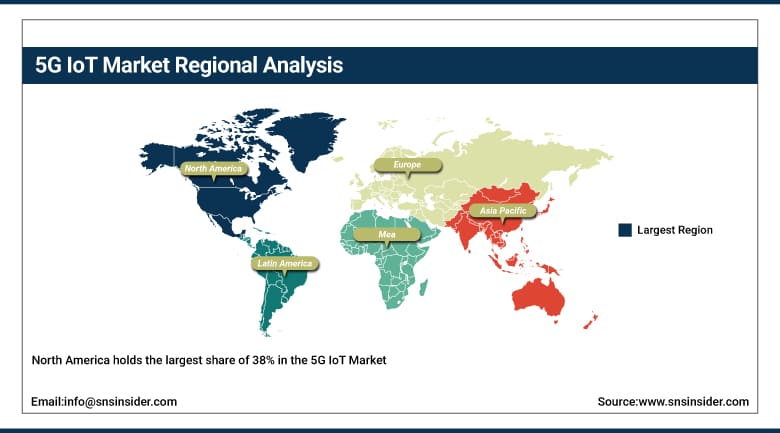
North America holds the largest share of 38% in the 5G IoT Market, with dominance mainly attributed to strong industrial, logistics, and transportation sectors, growing need for faster connectivity, and technological innovations in the energy and telecommunication sectors. That combination of established industrial infrastructure and expanding wireless 5G connection deployment kept the continent firmly positioned as the market's clear leader by a considerable margin over every other region tracked in this report.
The United States accounted for roughly 80.75% of regional revenue, anchored by strong industrial, logistics, and transportation sector 5G IoT adoption. Canada added further regional demand through its own growing telecommunications and industrial technology sector, and that combined strength kept North America the largest addressable market for 5G IoT vendors through the forecast period.
Get Customized Report as Per Your Business Requirement - Enquiry Now
Europe 5G IoT Market Insights
Europe held a meaningful share of global revenue, supported by continued enterprise digital transformation investment and growing private 5G network deployment across the region's major industrial economies. Rising demand for private 5G networks in manufacturing and enterprise environments kept reinforcing steady European demand throughout the year.
Germany led demand at roughly 23.95% of European revenue, supported by its substantial industrial manufacturing base and growing private 5G network adoption. The UK and France contributed substantial additional demand, and continued European investment in 5G infrastructure should keep regional demand climbing through the forecast period.
Asia Pacific 5G IoT Market Insights
The Asia Pacific 5G IoT market contributed the highest revenue share in certain source frameworks and continues registering the fastest growth trajectory among all regions tracked in this report. Rapid advancements in technology and expanding manufacturing, healthcare, and automotive sector 5G IoT adoption continued driving regional growth well ahead of every other region tracked in this report.
China led the pack, supported by its massive manufacturing base and rapidly growing domestic 5G infrastructure deployment. India and Japan contributed meaningful additional demand, with expanding manufacturing, energy, and transportation sector 5G IoT adoption continuing to reinforce Asia Pacific's position as the fastest-growing market tracked in this report.
MEA and Latin America 5G IoT Market Insights
The Middle East and Africa and Latin America both showed steady growth, driven by expanding telecommunications infrastructure investment, growing industrial automation adoption, and rising government focus on digital economy development across both areas. As these markets continued developing modern 5G infrastructure, IoT adoption grew correspondingly from a considerably smaller base than in more mature markets.
The UAE led Middle East and Africa demand, supported by substantial telecommunications infrastructure investment tied to the region's continued digital transformation agenda. Saudi Arabia contributed further demand through its own 5G infrastructure development programs. In Latin America, Brazil accounted for the largest share of regional revenue, with growing industrial automation adoption continuing to anchor regional demand for 5G IoT technology.
Growth Drivers: Ultra-Low Latency Demand and Connected Device Proliferation
The trend of integrating two advanced technologies is gaining traction around the world, benefiting the demand for 5G IoT. Use of 5G connectivity technologies to connect different IoT devices is estimated to bolster market growth, with low latency and better data transfer speeds representing prime benefits of 5G technology that IoT companies continue focusing on going forward.
Growing adoption of automation and rising popularity of connected devices continue helping the 5G IoT demand outlook, while advancements in artificial intelligence technologies continue promoting demand for edge and cloud computing. That combination of genuine connectivity performance advantage and expanding connected device ecosystem is exactly what keeps demand climbing at such a rapid, sustained pace across virtually every major consuming region this market serves.
Restraints: Semiconductor Tariff Pressure and Infrastructure Investment Requirements
Rising tariffs on 5G IoT components and semiconductors continue increasing costs for firms relying on global supply chains, posing a genuine restraint on faster market-wide cost reduction. That tariff pressure keeps enterprises reassessing procurement strategies and exploring regional manufacturing hubs, adding genuine complexity to supply chain planning across the broader 5G IoT hardware ecosystem.
The substantial capital investment required for standalone 5G core network deployment continues posing a further restraint, as telecommunications operators must commit significant infrastructure spending before genuinely unlocking 5G's full ultra-low latency and network slicing performance potential. That infrastructure investment requirement keeps full standalone 5G deployment a genuinely multi-year undertaking for many telecommunications operators.
Opportunities: Private 5G Network Expansion and SME Market Democratization
Rising demand for private 5G networks in manufacturing and enterprise environments represents a genuinely significant opportunity, as organizations increasingly seek dedicated, secure connectivity infrastructure capable of supporting mission-critical industrial IoT applications. Vendors offering genuinely proven, enterprise-grade private 5G network technology stand to capture meaningful share as this deployment model continues expanding across manufacturing and logistics sectors.
Rising SME adoption as 5G technology costs continue declining offers a second substantial opportunity, as this enterprise-size category's fastest-growing status reflects genuine demand democratization beyond the market's traditional large-enterprise stronghold. Vendors that can deliver genuinely affordable, accessible 5G IoT solutions stand to capture meaningful share as smaller organizations increasingly recognize the benefits of 5G-enabled connected device deployment.
Recent Developments
-
2025: Ericsson continued expanding its 5G IoT connectivity management and network infrastructure platform, targeting telecommunications operators and enterprise customers seeking scalable, reliable 5G connectivity solutions.
-
2025: Huawei continued advancing its 5G IoT chipset and network equipment technology, targeting manufacturing and industrial customers seeking cost-competitive, high-performance connected device infrastructure.
-
2024: Nokia continued expanding its private 5G network and industrial IoT solution portfolio, targeting manufacturing and logistics customers seeking dedicated, secure connectivity infrastructure for mission-critical applications.
5G IoT Market Key Players
-
Ericsson
-
Qualcomm Incorporated
-
Huawei Technologies Co., Ltd.
-
Siemens AG
-
Verizon Communications Inc.
-
Cisco Systems, Inc.
-
AT&T Inc.
-
Deutsche Telekom AG
-
Intel Corporation
-
Samsung Electronics Co., Ltd.
-
ZTE Corporation
-
Thales Group
-
Telefonaktiebolaget LM Ericsson
-
Fujitsu Limited
-
Honeywell International Inc.
-
Microsoft Corporation
-
Amazon Web Services, Inc.
-
IBM Corporation
5G IoT Market Report Scope:
| Report Attributes | Details |
|---|---|
| Market Size in 2025 | USD 14.00 Billion |
| Market Size by 2035 | USD 404.96 Billion |
| CAGR | CAGR of 40.0% From 2026 to 2035 |
| Base Year | 2025 |
| Forecast Period | 2026-2035 |
| Historical Data | 2022-2024 |
| Report Scope & Coverage | Market Size, Segments Analysis, Competitive Landscape, Regional Analysis, DROC & SWOT Analysis, Forecast Outlook |
| Key Segments | • By Component (Hardware, Platform, Connectivity, Services (Consulting Services, Deployment and Integration Services, Support and Maintenance Services)) • By Organization Size (Large Enterprises, SMEs) • By Network Type (5G Standalone, 5G non-standalone) • By Type (Short-range IoT Devices, Wide-range IoT Devices) • By End-User (Manufacturing, Healthcare, Energy & Utilities, Automotive and Transportation, Supply Chain & Logistics, Agriculture, Government & Public Safety, Others) |
| Regional Analysis/Coverage | North America (US, Canada), Europe (Germany, UK, France, Italy, Spain, Russia, Poland, Rest of Europe), Asia Pacific (China, India, Japan, South Korea, Australia, ASEAN Countries, Rest of Asia Pacific), Middle East & Africa (UAE, Saudi Arabia, Qatar, South Africa, Rest of Middle East & Africa), Latin America (Brazil, Argentina, Mexico, Colombia, Rest of Latin America). |
| Company Profiles | Ericsson,Nokia Corporation,Qualcomm Incorporated,Huawei Technologies Co., Ltd.,Siemens AG,Verizon Communications Inc.,Cisco Systems, Inc.,AT&T Inc.,Deutsche Telekom AG,Intel Corporation,Samsung Electronics Co., Ltd.,NEC Corporation,ZTE Corporation,Thales Group,Telefonaktiebolaget LM Ericsson,Fujitsu Limited,Honeywell International Inc.,Microsoft Corporation,Amazon Web Services, Inc.,IBM Corporation |

Frequently Asked Questions
The 5G IoT Market is expected to grow at a CAGR of approximately 40.0% from 2026 to 2035.
The 5G IoT Market was valued at approximately USD 14.00 Billion in 2025.
The major growth factor is the use of 5G connectivity technologies to connect different IoT devices, combined with low latency and better data transfer speeds.
The Connectivity segment dominated the 5G IoT Market.
North America dominated the 5G IoT Market in 2025.
